Food for a multi-day hike: 3, 5 or 7 days, by the gram
A walking day takes 3,000–4,000 kcal, and what that weighs depends on what you pack: 3,000 kcal is 750 grams of oats, or 1.25 kilos of bread. On a route of several days the food is the easy part. The water is what weighs.
By STOCKUP · Updated

In this guide (6)
A walking day: 2,500–4,500 kcal, 0.7–1.1 kg of food
REI’s planning guide puts a reasonable goal at 0.7 to 1.1 kg of food (1½ to 2½ lb) per person per day, or 2,500 to 4,500 kcal: a long, steep day needs a lot more than a few miles of flat trail.11 The Appalachian Trail Conservancy says 0.7–0.9 kg (1.5 to 2 lb) a day “to start”, if the food is high in calories, and more for days above 24 km (15 miles), for rough ground with a lot of climbing, and in winter.12 The mountaineering federations and the US Army count it in kilocalories:
- A summer day in the hills for a 65–70 kg walker with a 5–8 kg pack (French federation)2
- 4,000kcal
- Extra per hour of brisk walking, against sitting still (Spain’s FEDME)3
- 270kcal
- A man’s day of light to heavy work; for women 2,100–2,700 (US Army)4
- 3,000–3,700kcal
The French figure holds for summer, middle mountains and fair weather; the same person at a desk needs 2,000 kcal.2 The UIAA, the international mountaineering federation, works it out instead: resting metabolism times an activity factor, about 1.5 if you sit all day and 2.0 if you’re active.1 FEDME, Spain’s mountaineering federation, prices a brisk walk by the hour, so eight hours add about 2,160 kcal to a resting day.3
What moves you up or down the range is your own weight, the weight on your back, the ascent and the ground, the hours, and the heat. The US Army reckons a heavier load or rough ground (scree, sand, snow) each add about a quarter.4 The one study that tracked hill walkers for ten days found about 5,000 kcal a day, but those were fit men doing 21 km and 1,160 m of ascent daily.5
For planning, 3,000 kcal for an easy day and 4,000 for a long one with real climbing sits inside every source above. Don’t expect to match it: the French federation notes that a trip of several days ends in a food deficit as a rule, because everything has to be carried.2 The menu is a floor.
Grams per day: energy density decides
The weight follows from the energy. Divide the day’s kcal by what 100 g of your food carries. At the energy of rolled oats, about 400 kcal per 100 g, 3,000 kcal weighs 750 g. At white bread’s 240 it weighs about 1.25 kg; at nuts’ 590, about 510 g.6 Packaging comes on top. Thirty trail foods, per 100 g and per ounce, are in backpacking food by calorie density.
| kcal per 100 g | Grams for 1,000 kcal | |
|---|---|---|
| Extra virgin olive oil | 884 | About 115 g |
| Toasted almonds | 588 | About 170 g |
| Dark chocolate | 541 | About 185 g |
| Cured cheese (queso curado) | 448 | About 225 g |
| Cured sausage (salchichón) | 420 | About 240 g |
| White bread (pan de barra) | 239 | About 420 g |
Trail food by energy, from Spain’s food composition database6
Extra virgin olive oil
- kcal per 100 g
- 884
- Grams for 1,000 kcal
- About 115 g
Toasted almonds
- kcal per 100 g
- 588
- Grams for 1,000 kcal
- About 170 g
Dark chocolate
- kcal per 100 g
- 541
- Grams for 1,000 kcal
- About 185 g
Cured cheese (queso curado)
- kcal per 100 g
- 448
- Grams for 1,000 kcal
- About 225 g
Cured sausage (salchichón)
- kcal per 100 g
- 420
- Grams for 1,000 kcal
- About 240 g
White bread (pan de barra)
- kcal per 100 g
- 239
- Grams for 1,000 kcal
- About 420 g
Oil, nuts and chocolate carry more than twice bread’s energy per gram, mostly because a third of bread is water.6 A small bottle of olive oil earns its place: 11 g of it, a generous spoonful over dinner, is 100 kcal. A dried meal is dense because the water is out: Chicken & Rice carries 417 kcal per 100 g as sold. If you’re weighing pouches against each other by price, what a freeze-dried meal costs in Spain does that sum.
One day, breakfast to dinner
| Pouch | Net weight | Water | Energy |
|---|---|---|---|
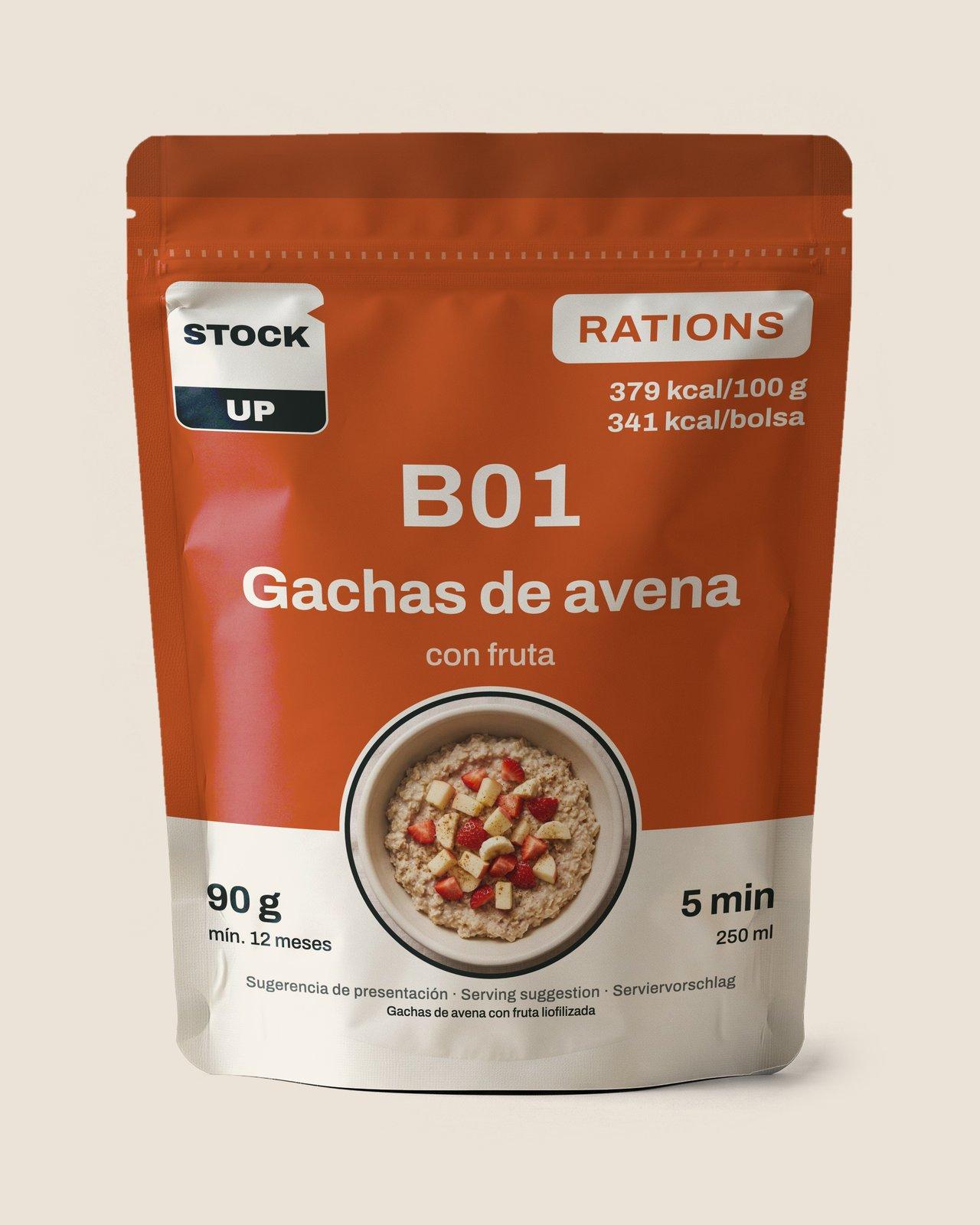 Porridge & Fruit | 90 g | 250 ml | 341 kcal |
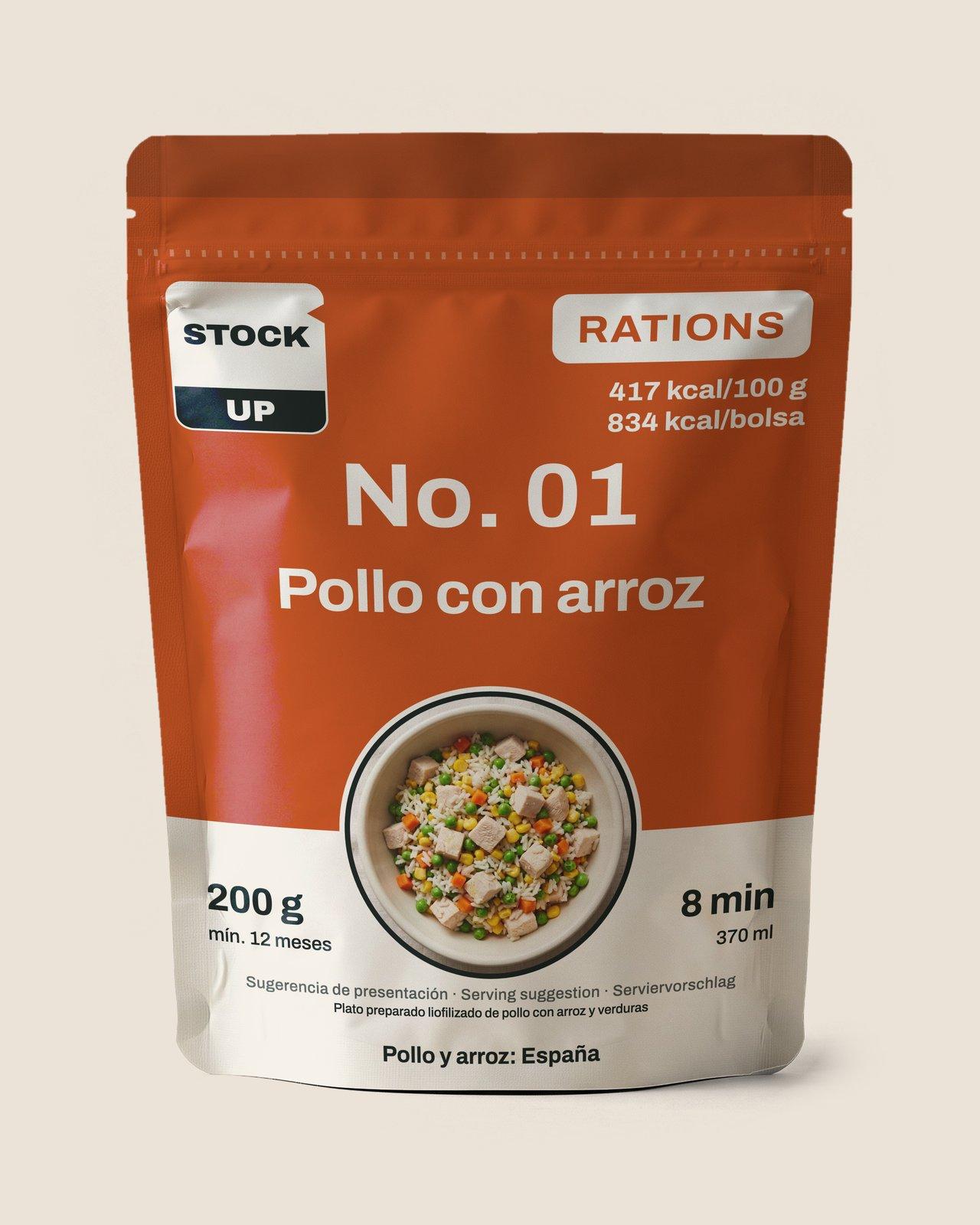 Chicken & RiceLarge | 200 g | 370 ml | 834 kcal |
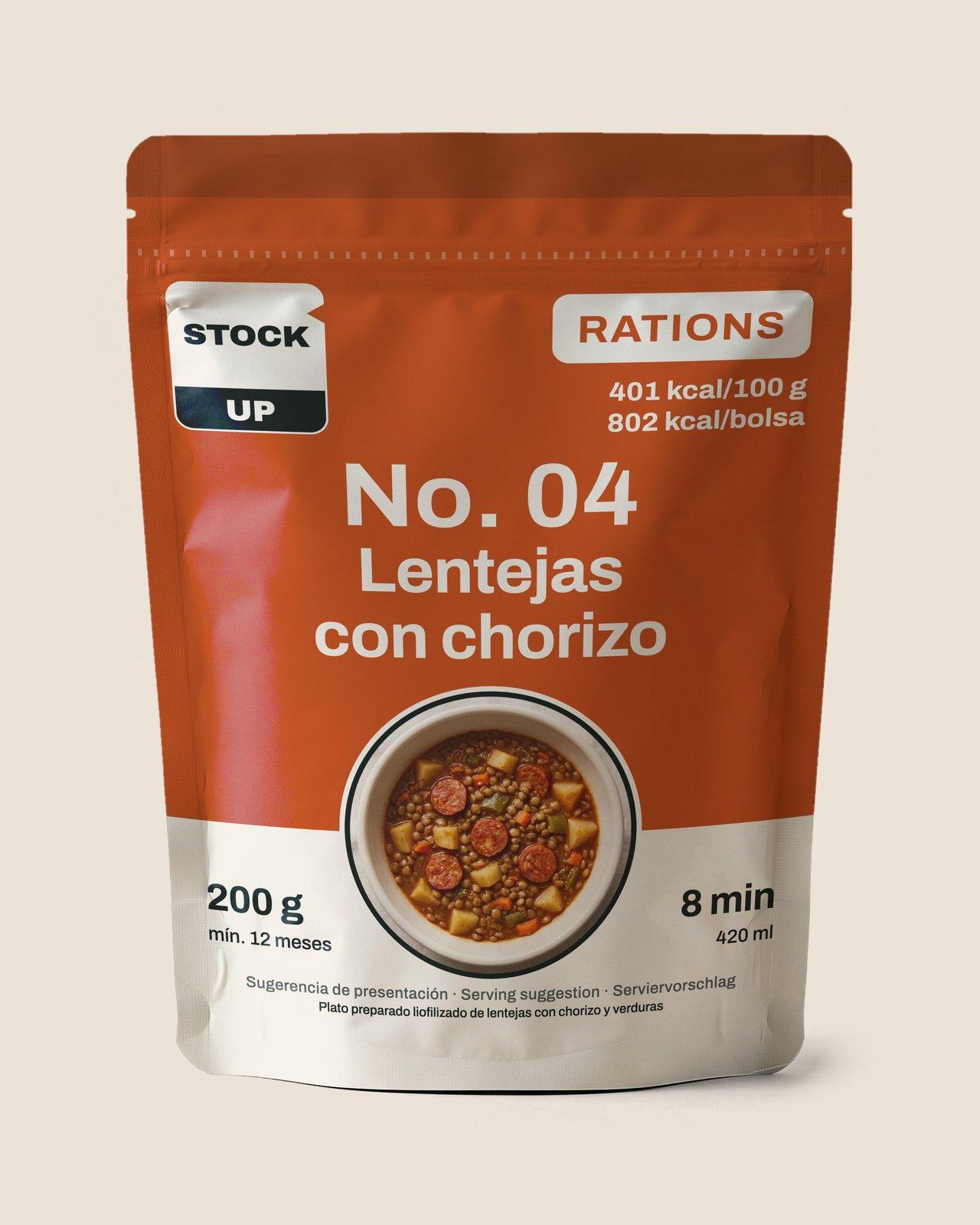 Lentils & ChorizoLarge | 200 g | 420 ml | 802 kcal |
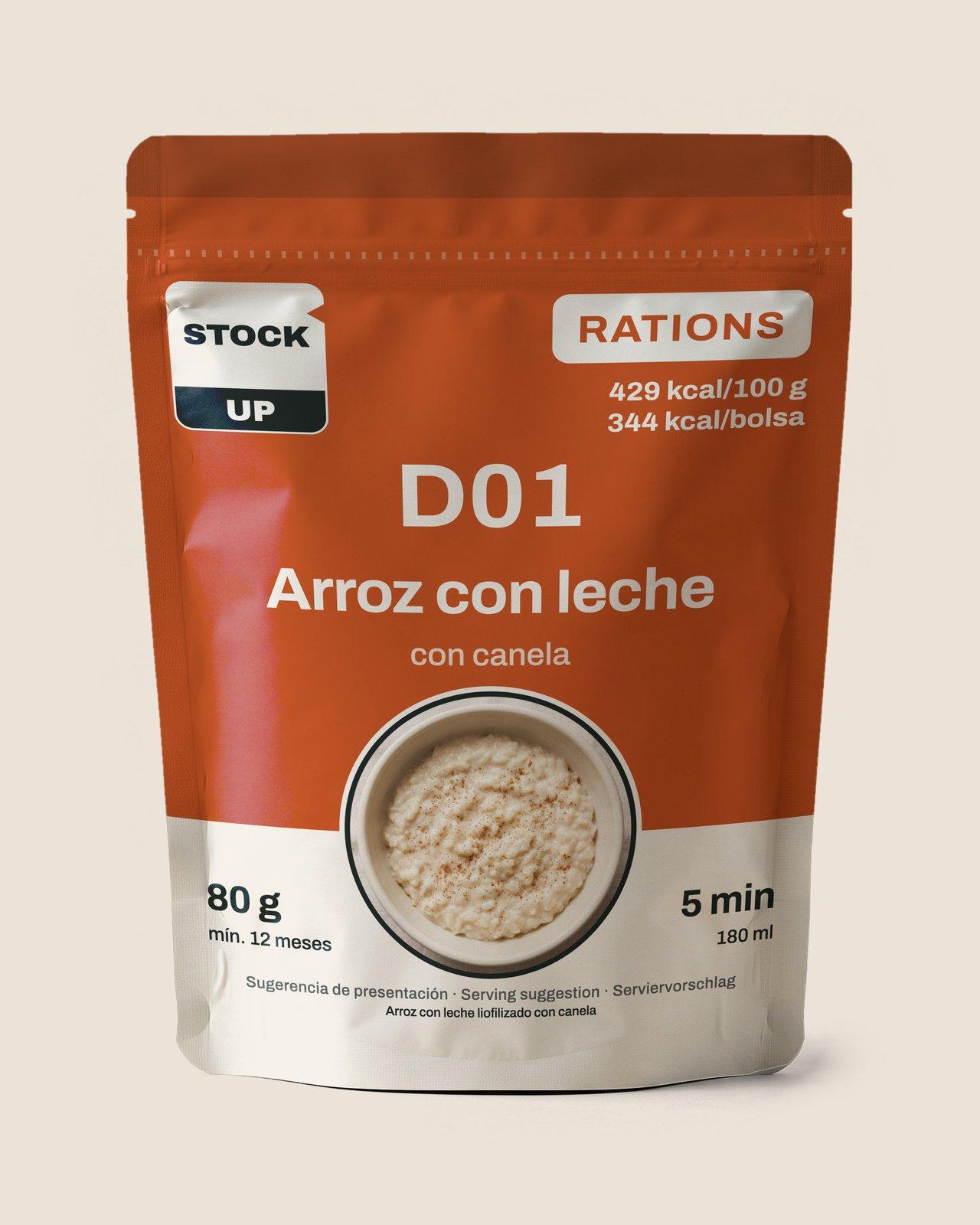 Rice Pudding with Cinnamon | 80 g | 180 ml | 344 kcal |
A walking day: breakfast, two Large mains and a pudding
- Porridge & Fruit
- Net weight
- 90 g
- Water
- 250 ml
- Energy
- 341 kcal
- Chicken & RiceLarge
- Net weight
- 200 g
- Water
- 370 ml
- Energy
- 834 kcal
- Lentils & ChorizoLarge
- Net weight
- 200 g
- Water
- 420 ml
- Energy
- 802 kcal
- Rice Pudding with Cinnamon
- Net weight
- 80 g
- Water
- 180 ml
- Energy
- 344 kcal
Breakfast is Porridge & Fruit, oats with milk and fruit already in, so it wants water and nothing else. Lunch is the chicken and rice, dinner the Lentils & Chorizo, and the rice pudding is for the tent. These four are the One-Day Ration.
The box covers the base; the snack bag does the rest. On the figures in the table, 160 g of almonds, 100 g of dark chocolate and 100 g of cured cheese come to about 1,930 kcal for 360 g.6 Eat from it through the day rather than saving it for the top. Freeze-dried fruit is the lightest thing you can add for something sweet that isn’t chocolate; how to use freeze-dried fruit covers it.
Three, five and seven days
| 3 days | 5 days | 7 days | |
|---|---|---|---|
| Pouches, dry | Three times 570 g | Five times 570 g | Seven times 570 g |
| Snack bag | 1.08 kg | 1.8 kg | 2.52 kg |
| Water the food takes, in all | Three times 1.2 l | Five times 1.2 l | Seven times 1.2 l |
| VerdictWhat changes | Fresh bread, tomatoes and cheese for day one | A resupply after day three: never more than three days on your back | Two resupplies, and swap the pouches so day six isn’t day one |
The same day, repeated: one person, the One-Day Ration plus a 360 g snack bag
Pouches, dry
- 3 days
- Three times 570 g
- 5 days
- Five times 570 g
- 7 days
- Seven times 570 g
Snack bag
- 3 days
- 1.08 kg
- 5 days
- 1.8 kg
- 7 days
- 2.52 kg
Water the food takes, in all
- 3 days
- Three times 1.2 l
- 5 days
- Five times 1.2 l
- 7 days
- Seven times 1.2 l
VerdictWhat changes
- 3 days
- Fresh bread, tomatoes and cheese for day one
- 5 days
- A resupply after day three: never more than three days on your back
- 7 days
- Two resupplies, and swap the pouches so day six isn’t day one
Fresh food is for the first day only. Fruit adds sugar and water, the French federation says, but it’s heavy and awkward to carry.2
The worked example: five days with a resupply after day three. You leave with three days of food, three times the box’s dry weight plus 1.08 kg of snacks, and pick up the other two days where you stop. On a long trip, vary the four: Perico Scrambled Eggs for breakfast, Lentil & Vegetable Stew for one dinner, a bag of Strawberries for the snack bag.
Water decides the weight
FEDME’s figure is 1.5 litres a person a day as a minimum, and much more in the heat, starting early.3 The UIAA puts total water from food and drink at about 2.5 litres a day for a 70 kg man and 2.2 litres for a 55 kg woman at sea level in a mild climate, and warns that sweat can reach 1.2 litres an hour with effort and heat.1 None of these figures counts the water a dried meal needs. That comes on top, and so does its weight.
Plan water stop by stop from the route’s own sheet, not from the map, and treat what you take from a stream or a trough: the methods and their times are in how to make water safe to drink.
Where you walk: water and fire
The food sum travels; the water figure and the fire rule belong to the mountains you’re in.
| Water a day | Fire and stoves | |
|---|---|---|
| United States | “2 liters of water a day or more” (about half a US gallon), as a rule of thumb (National Park Service)16 | Each national park has its own rules on where and when you can have a campfire: ask before you visit (National Park Service)17 |
| Scotland | No figure | A camping stove rather than a fire; no open fire in times of high fire risk14 |
| Germany (Bavaria) | At least 2 litres to carry on a day tour (German Alpine Club)13 | A permit for an open fire in a forest or within 100 m of one (Bavarian Forest Act, Art. 17)19 |
| Austria | About 1–2 litres to carry as a minimum, depending on the length of the tour (Austrian Alpine Club)22 | No fire in the forest or at the tree line without the forest owner’s written permission; near the forest too when conditions favour a forest fire (Forest Act, § 40)20 |
| Switzerland | At least 2–3 litres to drink in a day (Swiss Alpine Club)23 | The cantons decide, and their rules are the ones that count (Federal Office for the Environment)21 |
| Spain | At least 1.5 litres, much more in the heat (FEDME)3 | Andalusia: no fire to cook on or within 400 m of forest land, 1 June to 15 October7 |
Water and fire, six walking regions, as the sources say on the date under them
United States
Scotland
- Water a day
- No figure
- Fire and stoves
- A camping stove rather than a fire; no open fire in times of high fire risk14
Germany (Bavaria)
Austria
Switzerland
Spain
The three Alpine clubs aren’t measuring the same thing: the German and Austrian figures are what to carry, the Swiss one what to drink in a day. None of the three Alpine fire texts mentions a gas stove by name, and the bans tighten with the fire danger, by canton, state, park and forest, so check before the trip with the park, the forest office or the municipality. In the United States, the Forest Service’s camping page says to check whether fire restrictions are in place before starting a campfire, and never to use a flame or any other heating device inside a tent;18 the USDA’s food-safety service adds that many camping areas prohibit campfires.15
The Scottish code asks for the stove on a level, non-flammable surface away from dry grass, and your tent.14 Andalusia goes further: from 1 June to 15 October no fire may be lit to prepare food on forest land or within 400 m of it, even at picnic and camping areas built for it, and gas stoves appear in that order only as an exception for authorised tourist accommodation.7 The dates move: in 2025 the period ran to 31 October,8 and the Junta has suspended fire in spring by order too.10 Every Spanish region sets its own period; when the forecast fire risk is very high or extreme, the national law tells them to ban fire in all open spaces.9
So a summer trek in southern Spain is a cold-water trek, or a flask filled with hot water before you set off. With cold water, most of our mains and breakfasts take 20–30 minutes depending on the meal: the porridge about 20 minutes, the chicken and rice about 20 minutes, the lentils about 30 minutes. Cold water leaves meat and potato a little firmer, sometimes with a spoonful of liquid at the bottom; the method is in freeze-dried meals with cold water, and what else soaks well without a stove is in cold soaking. Leave the Porcini Mushroom Risotto at home in summer: it’s hot water only.
From our range
One-Day Ration
Sources
Accessed 10 November 2026
- Consideraciones nutricionales en montaña (opens an external website)
- Eléments de diététique, l’alimentation en randonnée (opens an external website)
- Iniciarse al senderismo (opens an external website)
- Nutrition and Menu Standards for Human Performance Optimization (opens an external website)
- Energy balance, metabolism, hydration, and performance during strenuous hill walking: the effect of age (opens an external website)
- Avena; aceite de oliva virgen extra; almendra tostada; nuez; chocolate negro; queso curado; salchichón; pan blanco (opens an external website)
- Limitaciones de usos y actividades en terrenos forestales (opens an external website)
- Decreto-ley 5/2026, de 20 de abril (opens an external website)
- Ley 43/2003, de 21 de noviembre, de Montes (opens an external website)
- Orden de 5 de mayo de 2023 (opens an external website)
- Backpacking food ideas & meal planning (opens an external website)
- Food, water & gear (opens an external website)
- Tourenverpflegung am Berg (opens an external website)
- Camping (opens an external website)
- Food safety while hiking, camping & boating (opens an external website)
- What to Bring – Camping (opens an external website)
- Campfires (opens an external website)
- Camping (opens an external website)
- Bayerisches Waldgesetz (BayWaldG), Art. 17 Feuergefahr (opens an external website)
- Forstgesetz 1975, § 40 (opens an external website)
- Aktuelle Gefahrenlage (opens an external website)
- Bergwandern (opens an external website)
- Sicher unterwegs – So wird das Wandern zum Vergnügen (opens an external website)
Hear from us before the shop opens
Leave your email. After a quick confirmation you get a welcome, a couple of short notes about our food and one email the day ordering opens. Nothing else.