Lost on a hike: what to do, who to call and how to signal
In Scotland’s mountain rescue figures for 2025, being lost was a factor in 60 of 491 incidents. The US Forest Service puts the first minutes in one line: stop, stay calm, stay put.
By STOCKUP · Updated

In this guide (5)
The first hour: stop, and stay findable
In Scottish Mountain Rescue’s figures for 2025, only slips and trips and medical problems came up more often than “lost”, and “navigation error” was a factor in another 47 incidents.1 The US Forest Service teaches the first minutes as STOP: stop, think, observe, plan.2 Canada’s AdventureSmart makes the S “sit”,3 and New Zealand’s Mountain Safety Council uses STAR, with assess and respond.4
Step by step
Stop
As soon as you think you may be lost: “stop, stay calm, stay put”, in the Forest Service’s words.2Think
Go back over how you got here and which landmarks you should be able to see. Don’t move until you have a specific reason to take a step.2Observe
Get out the compass and work out the directions from where you stand. If you’re on a trail, stay on it.2Plan
Come up with possible plans, think them through, then act on one.2Make yourself findable
Call for help if you can, then stay where you are: the National Park Service says to move only if there is an immediate threat to your life.5
If it’s nightfall, you are injured or you are near exhaustion, stay in place.
The Forest Service does mention following a drainage or stream downhill, but only “as a very last resort”, and adds: “this could be very dangerous.”2 Staying put shrinks the area a search has to cover, which is the reason AdventureSmart gives.3
Who to call, country by country
Dial the number of the country you’re standing in, not the one on your contract. Across the EU, if you can’t say where you are, the operator will work out where the call comes from, the European Commission says.6
| Number | Good to know | |
|---|---|---|
| United States | 9115 | Text-to-911 works only in some places; the FCC says to call whenever you can7 |
| United Kingdom | 999 or 1128 | Ask for “Police”, then “Mountain Rescue”. Texting 999 needs registering first: text “register” to 9998 |
| Australia | 000, or 112 from a mobile9 | 112 reaches the same Triple Zero service. With no coverage on any network, neither gets through, and 000 takes no texts9 |
| New Zealand | 1114 | Free, and works on a mobile with no credit left10 |
Emergency numbers outside the EU, as each authority gives them; as of the date under the sources
United States
United Kingdom
Australia
New Zealand
| Number | Good to know | |
|---|---|---|
| Every EU country | 1126 | Free, from fixed and mobile phones; it’s the number for the mountains in France and Italy too612 |
| Spain | 11211 | Mountain numbers vary by region: note the one for where you walk. 112 goes through on another operator’s network, but takes no text messages11 |
| Germany | 11212 | No signal: switch to flight mode and dial 112 again, or restart and enter 112 instead of the PIN1213 |
| Austria | 140, or 11214 | 140 is the alpine emergency number across Austria14 |
| Switzerland | 1414; 144 in Valais12 | 1414 is Rega and Alpine Rescue Switzerland; with a Swiss SIM from abroad, +41 333 333 33312 |
Latin America shares no number, and 112 isn’t a safe guess there: Colombia’s disaster agency prints it as the police line.
| Number | Good to know | |
|---|---|---|
| Mexico | 91119 | The single emergency number, answered by state and municipal call centres19 |
| Colombia | 12320 | The single national emergency line. 112 is listed as the national police, not as a general number21 |
| Argentina | 91122 | 106 is the coastguard on rivers, lakes and coasts, 100 the fire brigade, 103 civil defence. 107 for an ambulance is given only for Buenos Aires city and towns in its province22 |
| Peru | 105 police, 116 fire brigade, 106 ambulance2324 | No single number on the police’s or the health ministry’s page; 115 is civil defence23 |
| Chile | 131 ambulance, 132 fire brigade, 133 police25 | 136 is the Cuerpo de Socorro Andino, for emergencies in the mountains; 137 is for the sea and the coast26 |
Emergency numbers in Latin America, as each government gives them; as of the date under the sources
Mexico
Colombia
Argentina
Peru
- Good to know
- No single number on the police’s or the health ministry’s page; 115 is civil defence23
Chile
On the call, where you are comes first; Austria’s government puts it as the first question.14 The NPS asks for GPS coordinates from your phone if you have them, the trail or area you started from, your last known position, the landmarks you can see, the colours of your clothes, what you’re carrying, and any medical conditions.5 Mountain Rescue England and Wales adds the number of people in the party and your own mobile number, then asks you to stay where you are until the team makes contact.8
Some phones can now send an emergency message by satellite where there is no mobile or Wi-Fi coverage. Apple offers it on the iPhone 14 and later in 21 countries, among them the US, Canada, the UK, Spain, Germany, Austria, Switzerland, Australia and New Zealand, and you need to be outside with a clear view of the sky and horizon.15 Google offers it on Pixel phones from the Pixel 9, except the 9a, and says its country list “doesn’t guarantee coverage”.16 Check your own phone before the trip, not on the hill.
The signals rescuers look for: whistle and light
Two conventions exist, and they count differently. Use the one rescuers know where you are.
| Threes (North America) | Alpine distress signal (the Alps) | |
|---|---|---|
| By whistle | Three blasts, a break, three again5 | Six a minute, one every 10 seconds, then a minute’s pause, and repeat1714 |
| By light | Torch SOS: three times quickly, three times slowly, three times quickly5 | The same six a minute, by torch1714 |
| Other ways | Mirror flashes, horn blasts, signal fires or rock piles, each in threes3 | No figure |
| The rescuers’ answer | No figure | Three a minute, one every 20 seconds13 |
The two distress signals, as the bodies that teach them print them
By whistle
- Threes (North America)
- Three blasts, a break, three again5
By light
- Threes (North America)
- Torch SOS: three times quickly, three times slowly, three times quickly5
Other ways
- Threes (North America)
- Mirror flashes, horn blasts, signal fires or rock piles, each in threes3
- Alpine distress signal (the Alps)
- No figure
The rescuers’ answer
- Threes (North America)
- No figure
- Alpine distress signal (the Alps)
- Three a minute, one every 20 seconds13
The NPS says to blow the whistle often rather than shout, to save your energy.5 For aircraft, the NPS suggests a mirror and laying out your shelter or rocks in a shape that shows from the air;5 New Zealand’s council adds bright items in open ground and arrows of rock or sticks pointing to where you are.4 The NPS is clear about fire: none if the fire risk is high or it’s wildfire season.5
Before you leave: what to tell someone
| What to leave | With whom | |
|---|---|---|
| US Forest Service | Where you’re going, the trail, when you’ll be back, the car and where it’s parked, how many of you there are2 | Someone you tell; and don’t go alone2 |
| US National Park Service | A written trip plan5 | A trusted contact who isn’t on the trip5 |
| FEDME (Spain) | The route you’re doing, and a call when you’re back11 | A relative or a friend11 |
What to leave behind, as each body asks for it
US Forest Service
US National Park Service
FEDME (Spain)
FEDME’s second half is what makes the first one work: someone who expects your call knows when to raise the alarm. The car is part of the plan too, and the car emergency kit list covers what stays in it. For walks in southern Spain, the route guides carry each route’s own figures: the Torrecilla hike, Mulhacén over two days, Los Reales de Sierra Bermeja and La Concha from Refugio de Juanar.
What’s in the pack for a night you didn’t plan
“Help can take hours or days depending on your location, weather, and resources,” the NPS warns.5 Its ten essentials are the kit for that wait, and three of them do most of the work when you’re lost: navigation (map, compass and GPS), light (a torch or headlamp, which also signals), and emergency shelter (a tent, space blanket, tarp or bivy bag).18 Don’t count on the phone: the Forest Service expects mobiles often won’t have signal, and GPS units can lose theirs or run flat.2
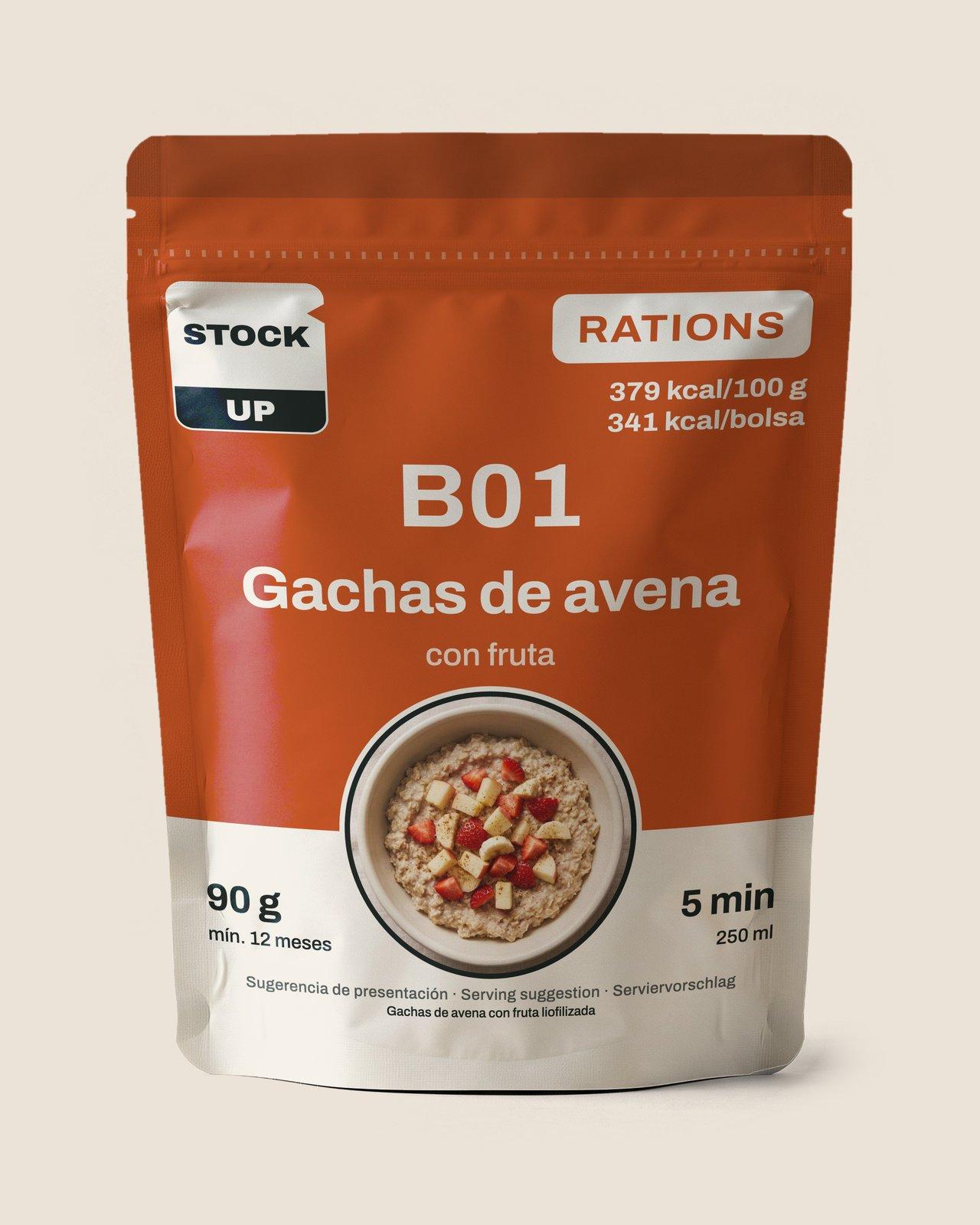
The food line is short: “an extra day’s supply of food”, preferably food that needs no cooking,18 and the park service’s emergency plan suggests fruit, nuts and salty snacks.5 If the extra day is meals rather than snacks, the way to plan them over a longer walk is in food for a multi-day hike, and the One-Day Ration holds Porridge & Fruit, Chicken & Rice, Lentils & Chorizo and Rice Pudding with Cinnamon; they need water, so they belong with a full bottle. Food is the last of four priorities, after air, protection from cold or heat, and water: the order of the rule of threes, set against its sources in how long you can go without water or food.


From our range
One-Day Ration
Sources
Accessed 10 November 2026
- Statistics Report 2025 (opens an external website)
- If You Get Lost (opens an external website)
- Home page of the programme (opens an external website)
- Emergencies and Survival (opens an external website)
- Outdoor Emergency Plan (opens an external website)
- Page on 112, the European emergency number (opens an external website)
- Text to 911: What You Need to Know (opens an external website)
- In case of emergency (opens an external website)
- Page on the Triple Zero (000) emergency number (opens an external website)
- Page on calling 111 (opens an external website)
- Iniciarse al senderismo (opens an external website)
- Notruf und Rettung in den Alpen (opens an external website)
- Wie funktioniert das Notrufsystem (opens an external website)
- Verhalten bei Lawinenunfällen und Bergunfällen (opens an external website)
- Support article 101573 on Emergency SOS via satellite (opens an external website)
- Help article 15254448 on Satellite SOS (opens an external website)
- So geht das: Notfall alpin (opens an external website)
- 10 Essentials (opens an external website)
- Número Único de Emergencias 9-1-1 (opens an external website)
- Línea única de emergencias Nacional 123 (opens an external website)
- Guía de preparativos ante sismo (opens an external website)
- Emergencias (opens an external website)
- Contacto y números de emergencia (opens an external website)
- Contacto y números de emergencia (opens an external website)
- Condiciones de seguridad (opens an external website)
- Emergencias en Chile (opens an external website)
Hear from us before the shop opens
Leave your email. After a quick confirmation you get a welcome, a couple of short notes about our food and one email the day ordering opens. Nothing else.