What freeze-drying does to nutrients
Water is the only thing freeze-drying is meant to take out. Researchers have measured what else goes with it, and the answer changes from one fruit to the next.
By STOCKUP · Updated

In this guide (5)
Gentler than hot air, and still not lossless
Vitamins in drying food have three enemies: oxygen, heat and damaged cells. Freeze-drying takes away most of the first two, because the water leaves as ice, at low temperature, in a vacuum;1 the difference between freeze-dried and dehydrated goes through the stages. In every pairing below, it kept more than hot air.
| Freeze-dried | Hot air | |
|---|---|---|
| Vitamin C, kiwifruit | 56% kept2 | 22% kept2 |
| Vitamin C, guava | 63% kept1 | 25% kept, heat-pump dryer at 45 °C1 |
| Carotenoids, sea buckthorn | 93% more than hot air1 | The baseline: air at 50–60 °C1 |
| VerdictWhat to expect from a pouch | Energy and protein as the label says; no vitamin promise | The same: read the table on the back |
What happens to vitamins and carotenoids, freeze-dried against hot air, with the source for each figure
Vitamin C, kiwifruit
Vitamin C, guava
Carotenoids, sea buckthorn
VerdictWhat to expect from a pouch
- Freeze-dried
- Energy and protein as the label says; no vitamin promise
- Hot air
- The same: read the table on the back
More than hot air still isn’t all of it. Across tropical fruits, freeze-drying lost between 3% and 70% of the vitamin C, depending on the fruit, and blueberries lost a clear share under every setting tried.1 In one Malaysian study, mango, papaya and starfruit kept their vitamin C, but mango lost about a quarter of its beta-carotene.3 The review behind most of these figures comes to the same conclusion: some vitamins are lost, and freeze-drying still keeps more than the other drying methods.1
So nobody should buy a dried meal for its vitamins. Ours declare none.
What only gets more concentrated
Sublimation takes out water and nothing else. Energy, protein, fat, carbohydrate, sugars, fibre, salt and minerals stay in the pouch, so per 100 g they rise by the same factor as the weight falls, and per portion they’re what they were in the dish that went in. The labels of freeze-dried broccoli, pineapple and cooked chicken compare well with the raw or frozen food.4
That’s also why a dry pouch looks dense on paper. The figure per 100 g describes the dry food; the figure per pouch describes your dinner.
The cooking costs vitamins before the drying does
A cooked dish loses its share of vitamins on the hob, long before it meets a freezer. The USDA’s retention tables put numbers on it: beef simmered and served with its liquid keeps 85% of its vitamin C, 60% of its thiamin and 50% of its vitamin B6; rice cooked until the water is absorbed keeps 80% of its thiamin; boiled root vegetables, with the water used, keep 75% of their vitamin C.5 Minerals aren’t destroyed by heat. They move into the cooking liquid, so they stay in a dish that keeps its sauce and leave with water that’s poured away.5
Ours are cooked first, then freeze-dried whole, sauce and all, so whatever the cooking moved into the sauce goes into the pouch with it.
Vitamin C keeps falling on the shelf
Dry isn’t frozen in time. Vitamins go on declining in the pouch, vitamin C most of all, which can fall markedly within one to three years.6 In freeze-dried peppers stored at 5 °C, vitamin C fell sixteen times more slowly than in fresh ones, but it still fell, by half in about 160 days.7 A freeze-dried military meal with added vitamins kept, after 24 months, 94% of its vitamin B1, 97% of B2, 86% of B6 and 77% of vitamin E.8 Fats and fat-soluble vitamins need the most care, because very dry food speeds up their oxidation.1 It’s one reason every pouch carries a date, and how long freeze-dried food keeps explains what the date promises.
Reading a label: our chicken and rice
EU law decides what a nutrition label shows and how. The table gives energy, fat, saturates, carbohydrate, sugars, protein and salt,9 always per 100 g, and per portion as well if the portion is stated on the pack.9 The values are those of the food as sold, unless the label gives detailed preparation and says they refer to the food as prepared.9 A vitamin may only be listed where there’s a significant amount, as a rule 15% of its reference value per 100 g; for vitamin C that’s 12 mg.9
Take our Chicken & Rice. One pouch gives 459 kcal and 42 g of protein; per 100 g, the column that lets you compare it with other food, that’s 417 kcal and 38 g. The larger Chicken & Rice is the same recipe in a bigger pouch: 834 kcal and 75 g, with the same figures per 100 g. The values are averages calculated from the recipe, as the line under each table says. Each figure is rounded on its own, so doubling one doesn’t always give the other to the gram.
| Pouch | Energy | Protein | Energy per 100 g | Protein per 100 g |
|---|---|---|---|---|
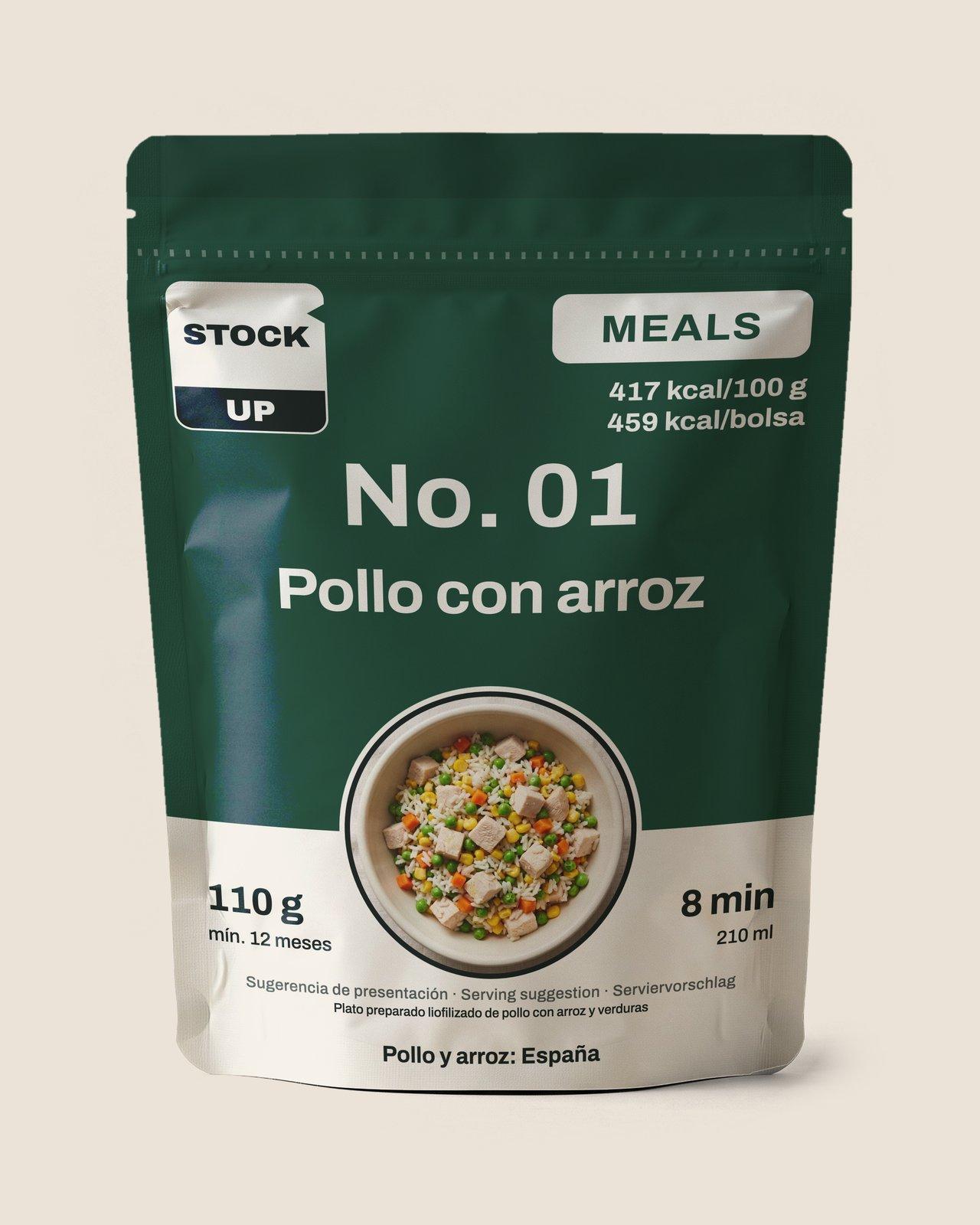 Chicken & RiceStandard | 459 kcal | 42 g | 417 kcal | 38 g |
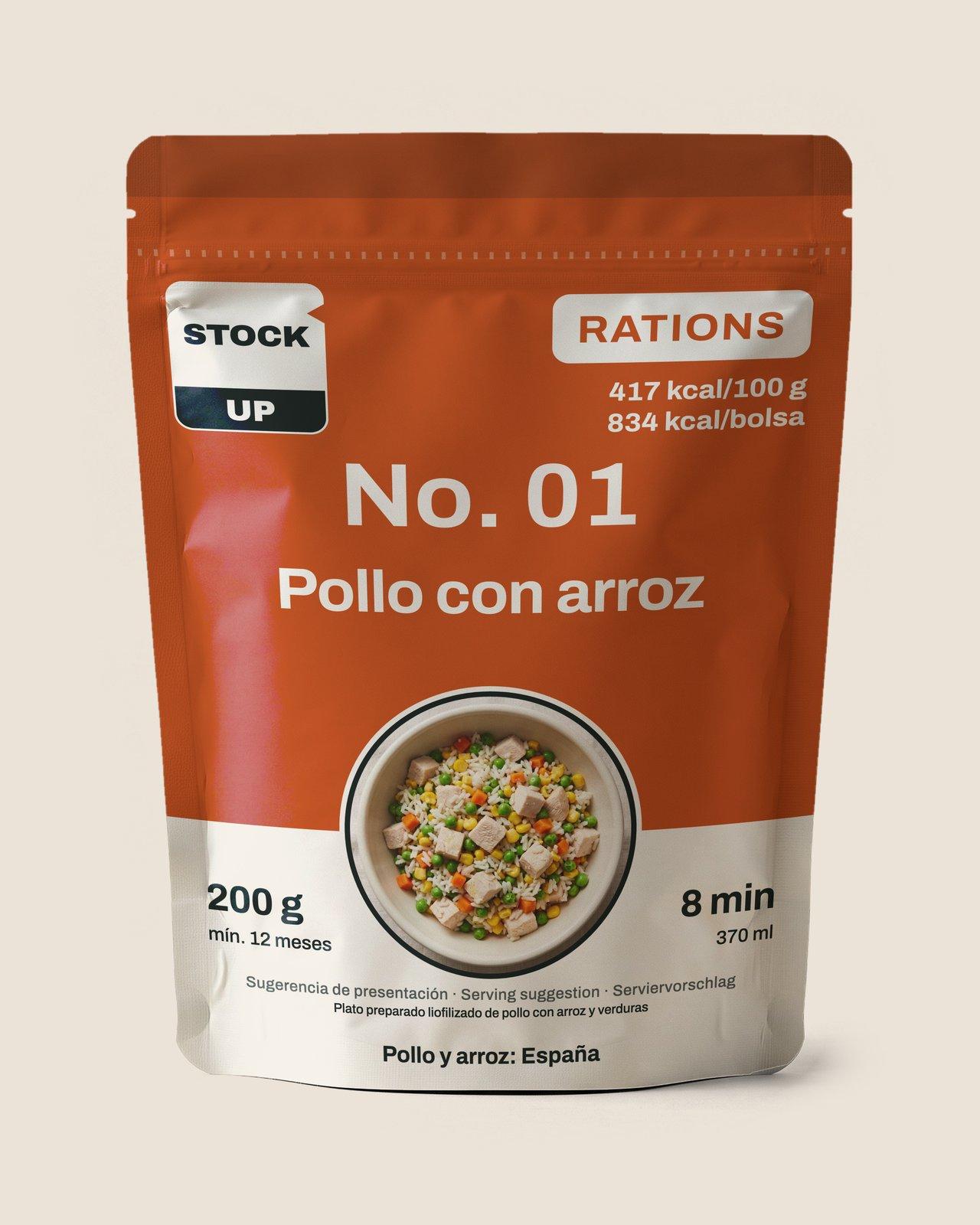 Chicken & RiceLarge | 834 kcal | 75 g | 417 kcal | 38 g |
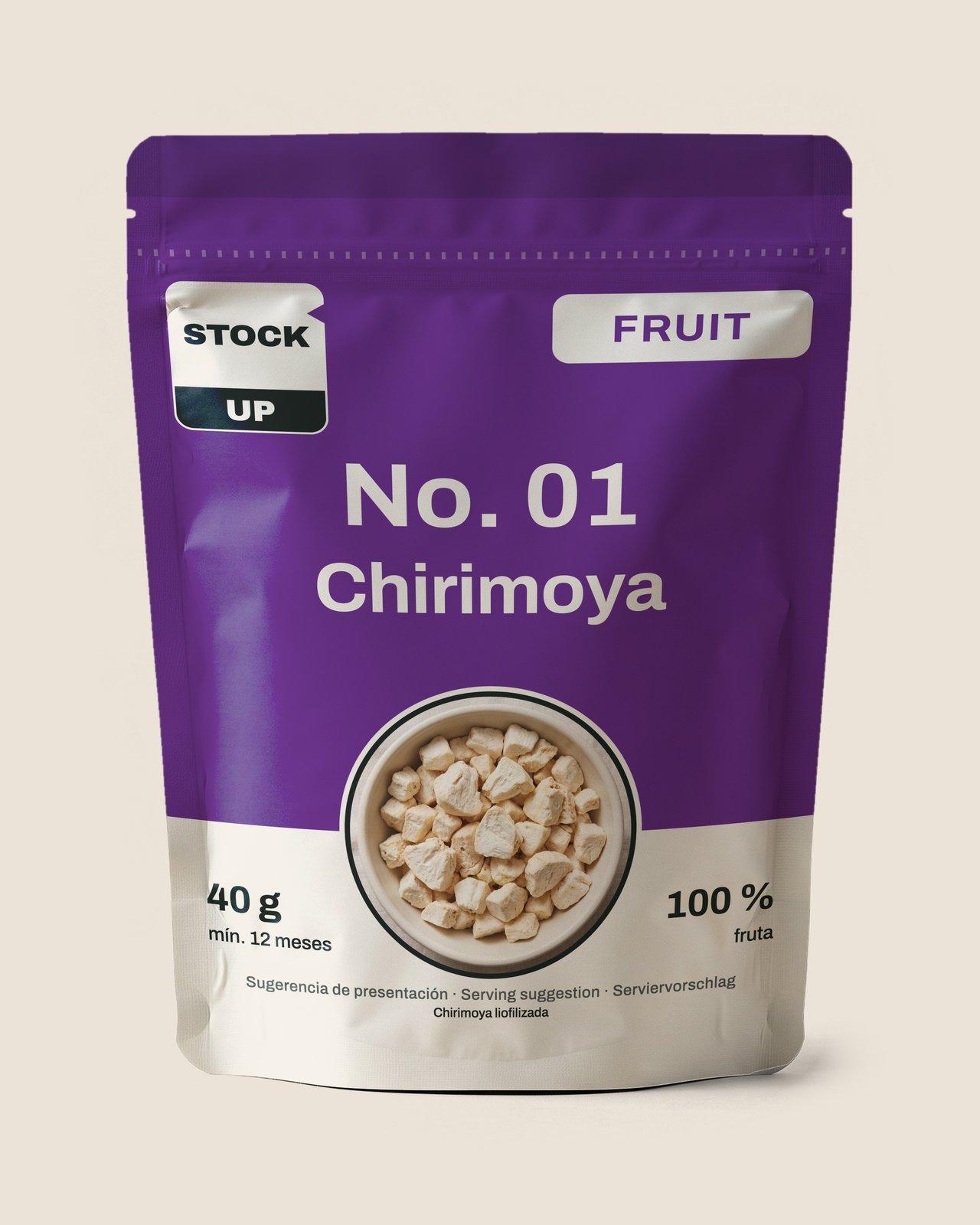 Cherimoya | 145 kcal | 3 g | 364 kcal | 7.4 g |
Per pouch and per 100 g: the same recipe in two sizes, and a fruit for contrast
- Chicken & RiceStandard
- Energy
- 459 kcal
- Protein
- 42 g
- Energy per 100 g
- 417 kcal
- Protein per 100 g
- 38 g
- Chicken & RiceLarge
- Energy
- 834 kcal
- Protein
- 75 g
- Energy per 100 g
- 417 kcal
- Protein per 100 g
- 38 g
- Cherimoya
- Energy
- 145 kcal
- Protein
- 3 g
- Energy per 100 g
- 364 kcal
- Protein per 100 g
- 7.4 g
The Cherimoya bag is there for contrast: fruit and nothing else, so its energy is the fruit’s own sugar, concentrated. What that means for a portion is worked out in freeze-dried fruit.
“High protein” on the front of a pouch is a legal term. It may only be used where at least 20% of the food’s energy comes from protein, and “source of protein” needs 12%.10 Because the rule is a share of energy, drying doesn’t change it: a dish that qualifies dry qualifies made up with water. Our chicken and rice qualifies; the Lentil & Vegetable Stew is labelled a source of protein.
From our range
Chicken & RiceStandard
Sources
Accessed 10 November 2026
- Freeze-drying of plant-based foods (opens an external website)
- Effects of major drying methods on the stability and retention of vitamin C, B group vitamins, fat-soluble vitamins, and carotenoids in kiwifruits (opens an external website)
- Effect of freeze-drying on the antioxidant compounds and antioxidant activity of selected tropical fruits (opens an external website)
- Buying a home freeze-dryer: what to know before you go (opens an external website)
- Table of nutrient retention factors, release 6 (opens an external website)
- Can I freeze-dry that? A practical guide to safe and effective freeze-drying (opens an external website)
- Stability of vitamin C in fresh and freeze-dried capsicum stored at different temperatures (opens an external website)
- Stability of vitamins B1, B2, B6 and E in a fortified military freeze-dried meal during extended storage (opens an external website)
- Regulation (EU) No 1169/2011 on the provision of food information to consumers (opens an external website)
- Regulation (EC) No 1924/2006 on nutrition and health claims made on foods (opens an external website)
Hear from us before the shop opens
Leave your email. After a quick confirmation you get a welcome, a couple of short notes about our food and one email the day ordering opens. Nothing else.