Car emergency kit: the list, and what each country makes you carry
Car lists from five countries agree on one item: something warm. The law is another matter: Spain wants a connected beacon, Belgium an extinguisher, the Netherlands nothing at all, and the kit goes by where the car is registered.
By STOCKUP · Updated

In this guide (6)
The list: breakdown, cold and heat
Eight car lists from the US, Canada, Ireland, Britain and Spain, seven of them official and one from the American motoring club AAA, agree on only one item: something warm. Seven of the eight name a torch, water, food and an ice scraper, and five a first-aid kit and a warning device. The list prints, for the inside of the boot lid.
The kit for the boot
0 of 23 ticked
Your ticks stay in this browser only.
In heat, the rule that matters is Ready.gov’s: “Never leave people or pets in a closed car on a warm day.”13 The Highway Code adds one for the driver: keep the car well ventilated, to avoid drowsiness.7 Food in the boot is kept the way its label says, like any packed food, and that goes for our pouches too.
What the law makes you carry, country by country
Here the lists stop agreeing. Each country sets the equipment for the cars registered there, and its rules on the road, such as wearing the vest when you get out, apply to everyone driving in it. Check the rules of every country you drive through before you travel.
| Warning device | Vest | First-aid kit | Other | |
|---|---|---|---|---|
| United Kingdom | Triangle advised, at least 45 m behind; never on a motorway14 | Light or reflective clothing advised14 | Not mentioned | Not mentioned |
| Ireland | Triangle advised15 | Not mentioned | Advised15 | Extinguisher and spare bulbs advised15 |
| Spain | Connected V-16 beacon, since 1 January 20262 | Carry one16 | Not on the list16 | Spare wheel and tools, or an alternative16 |
| France | Triangle, 30 m or more behind3 | Within reach; worn when you get out3 | Not mentioned | Winter tyres or chains in some mountain areas, 1 November to 31 March; no breathalyser needed3 |
| Portugal | Triangle, 30 m or more behind17 | Carry one; worn when placing the triangle17 | Not mentioned | Not mentioned |
| Italy | Triangle18 | Worn when you get out on the road outside towns18 | Not mentioned | Not mentioned |
Britain, Ireland and southern Europe: what a private car carries, as each text stood on the date under the sources. “Not mentioned” means the text we read doesn’t mention it; it may still be required.
United Kingdom
Ireland
Spain
France
Portugal
Italy
| Warning device | Vest | First-aid kit | Other | |
|---|---|---|---|---|
| Germany | Triangle19 | One per car19 | To DIN 13164, in a dust- and damp-proof box20 | Not mentioned |
| Austria | A warning device21 | Carry one; worn when placing the warning device, or outside the car on a motorway or expressway21 | Dressings, in a sturdy dustproof box21 | In winter conditions, 1 November to 15 April: winter tyres, or chains on snow and ice21 |
| Switzerland | Triangle22 | Not mentioned | Not mentioned | Not mentioned |
| Belgium | Triangle23 | Carry one23 | Carry one23 | Fire extinguisher23 |
| Netherlands | Not required24 | Not required; advised abroad24 | Not required24 | Not mentioned |
| Mexico, federal roads | Lights and fluorescent triangles, or another visible device, when stopped25 | Not mentioned | Not mentioned | Spare tyre25 |
Central Europe, the Low Countries and Mexico: what a private car carries, as each text stood on the date under the sources
Germany
Austria
Switzerland
- Warning device
- Triangle22
- Vest
- Not mentioned
- First-aid kit
- Not mentioned
- Other
- Not mentioned
Belgium
Netherlands
Mexico, federal roads
Spain is the case that catches people out. Since 1 January 2026 the connected V-16 beacon, a yellow light placed as high on the car as possible that reports its position to the national traffic platform, is the only legal way for a Spanish-registered car to signal a breakdown on the carriageway; old unconnected beacons no longer count.216 A car registered elsewhere still complies in Spain with the triangles of its own country, and the DGT says a Spanish car complies with its V-16 in any country that signed the 1968 Vienna Convention.2 A hire car carries the kit of the country it’s registered in; the Austrian motoring club ÖAMTC gives a Spanish hire car with its V-16 as the example.26 GOV.UK puts the check on you: if you’re hiring, it’s your responsibility to make sure the equipment is there.27
In the United States the federal standard for warning devices is written for trucks and buses over 10,000 lb (about 4,500 kg);28 with a private car, check the rules of each state you drive through. Canada’s federal car-kit pages are advice, and their lines are in the list above;68 in Canada and Australia, check the province’s or state’s rules before you travel, and in New Zealand the national ones.
Get out, or stay in: two different situations
The advice to get out and the advice to stay in are both right, for two different places to be stuck.
Water on the road is the third case, and Ready.gov gives the figures: 15 cm (6 inches) of water can make a car lose control or stall, and 30 cm (1 foot) will float many cars.1 If you do have to walk, the steps for finding your way and being found are in what to do if you get lost on a hike.
Water and food for a 24-hour wait
None of the car lists gives litres or grams. The household figures do, and a day in a car is a day like any other.
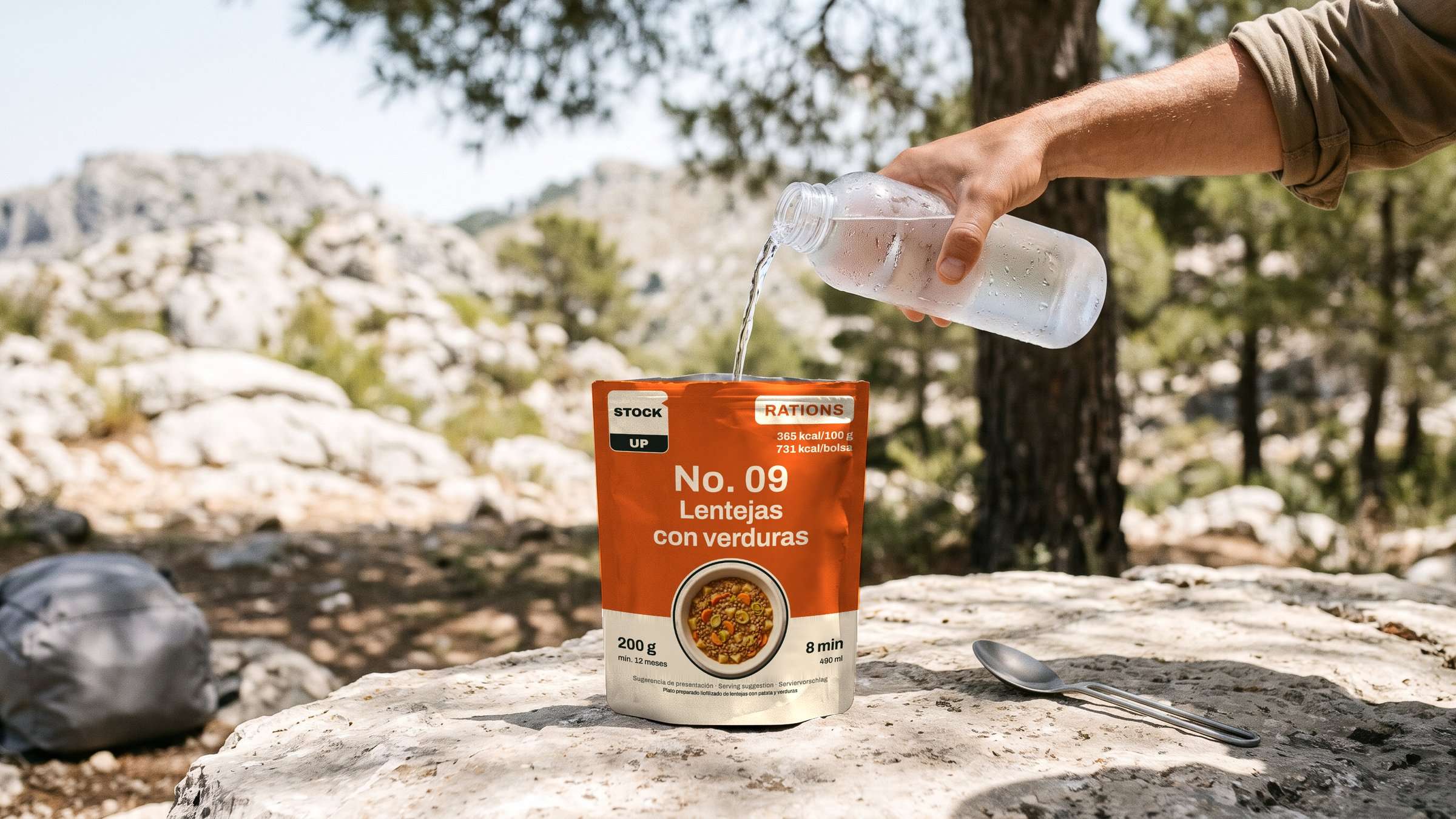
Dried food takes its water from the same bottles you drink from, so if the boot holds pouches, count that water in. Most pouches work with cold water, 20–30 minutes depending on the meal: Chicken & Rice needs 370 ml and about 20 minutes; for Guacamole it’s cold water only. The working out for a longer stretch is in how much water to store per person, and the same food logic for a tent is in camping food with no fridge and no flame.
When to check it
A kit in the boot ages faster than one in a cupboard, and four things in it have a clock:
- The beacon: the DGT recommends new batteries every year, or a full charge at least once a year for a rechargeable one, and keeping it in the glovebox, charged.2
- The torch: Ireland says check it monthly.4
- The water: Canada says change the bottles every six months.6
- The fuel: Ready.gov says keep the tank full; in winter that also keeps the fuel line from freezing.1
Before a winter trip add the chains, and before any trip abroad, the tables above. If you also keep a bag by the door for leaving on foot, it shares half this list: the go bag list has the rest.
The food in the kit
One-Day Ration is a day’s food in one box: breakfast, two mains and a pudding, each sealed in its own pouch. It’s the food in a car kit, not the kit: the blanket, the torch and the vest stay on your list.



From our range
One-Day Ration
Sources
Accessed 10 November 2026
- Car Safety (opens an external website)
- Dispositivos de preseñalización V16 (opens an external website)
- Équipements obligatoires en voiture : gilet de sécurité, triangle... (opens an external website)
- Road safety (opens an external website)
- Winter Driving Tips (opens an external website)
- Emergency car kit (opens an external website)
- Driving in adverse weather conditions (226 to 237) (opens an external website)
- Winter Driving Emergency Kit (opens an external website)
- Get prepared for emergencies (opens an external website)
- Conducir con hielo y nieve (opens an external website)
- Cómo planificar un viaje seguro por carretera (opens an external website)
- Water (opens an external website)
- Extreme Heat (opens an external website)
- Breakdowns and incidents (274 to 287) (opens an external website)
- Advice for using the roads in Ireland (opens an external website)
- Real Decreto 2822/1998, de 23 de diciembre, por el que se aprueba el Reglamento General de Vehículos (opens an external website)
- Código da Estrada (opens an external website)
- Decreto legislativo 30 aprile 1992, n. 285 (Codice della strada), art. 162 (opens an external website)
- Straßenverkehrs-Zulassungs-Ordnung (StVZO), § 53a (opens an external website)
- Straßenverkehrs-Zulassungs-Ordnung (StVZO), § 35h (opens an external website)
- Kraftfahrgesetz 1967, § 102 (opens an external website)
- Verordnung über die technischen Anforderungen an Strassenfahrzeuge (VTS), Art. 90 (opens an external website)
- Arrêté royal du 15 mars 1968 portant règlement général sur les conditions techniques des véhicules automobiles (opens an external website)
- Wat moet ik verplicht in mijn auto hebben? (opens an external website)
- Reglamento de Tránsito en Carreteras y Puentes de Jurisdicción Federal (opens an external website)
- Mitführpflichten für Autofahrer in Europa (opens an external website)
- Driving abroad (opens an external website)
- 49 CFR 571.125, Standard No. 125; Warning devices (opens an external website)
- Real Decreto 1428/2003, de 21 de noviembre, por el que se aprueba el Reglamento General de Circulación (opens an external website)
- Winter storm: during (opens an external website)
- Vorratskalkulator (opens an external website)
Hear from us before the shop opens
Leave your email. After a quick confirmation you get a welcome, a couple of short notes about our food and one email the day ordering opens. Nothing else.