How long you can go without water or food, and the rule of threes
Three minutes without air, three hours without shelter, three days without water, three weeks without food. Nobody knows who wrote the rule, and set beside the published sources, the order holds and the numbers don’t.
By STOCKUP · Updated

In this guide (4)
The rule of threes, and what it’s for: an order
Every survival forum knows the rule of threes: three minutes without air, three hours without shelter in harsh weather, three days without water, three weeks without food. Who first wrote it down, and when, isn’t on record. It circulates on survival blogs and gear shops’ pages, rarely from an official body. One that does print it, the health department of Tooele County in Utah, puts “about” in front of every line and adds that “it is not absolute”, but gives “good general direction”.1
That is the fair reading. As a list of priorities it works: air, then protection from cold or heat, then water, then food. As four numbers it doesn’t. Set each line beside what physiologists and health authorities have published, and the order survives while every number either has no source or is contradicted by one. For the narrower case of being lost there is a mnemonic that an official body does teach: STOP, on the US Forest Service’s page.2
Air, shelter, water, food: what each source says
| What the rule says | What the sources say | What it changes in the pack | |
|---|---|---|---|
| Air | About three minutes in unsafe air1 | Some brain cells start dying “within minutes” once their oxygen supply stops5 | At home, what may burn indoors and what may not: how to cook without power |
| Shelter from cold or heat | About three hours at a dangerous temperature1 | Cold-water shock acts in the first minute;6 heat stroke can take body temperature to 41 °C (106 °F) or higher within 10 to 15 minutes;7 at the other end, immersions of up to 75 hours in water below 20 °C are on record8 | An extra layer, and the emergency shelter of the ten essentials: tent, space blanket, tarp or bivy bag9 |
| Water | About three days1 | Its absence is “lethal within days”;10 more important than food, says Germany’s civil protection office11 | Water before food, and a way to treat more |
| Food | About three weeks1 | Twenty hunger strikers who kept drinking died after 62.5 days on average, with a range of 11 to 11512 | The lightest of the four to carry: an extra day’s supply9 |
The rule of threes against its sources
Air
- What the rule says
- About three minutes in unsafe air1
- What the sources say
- Some brain cells start dying “within minutes” once their oxygen supply stops5
- What it changes in the pack
- At home, what may burn indoors and what may not: how to cook without power
Shelter from cold or heat
- What the rule says
- About three hours at a dangerous temperature1
- What the sources say
- Cold-water shock acts in the first minute;6 heat stroke can take body temperature to 41 °C (106 °F) or higher within 10 to 15 minutes;7 at the other end, immersions of up to 75 hours in water below 20 °C are on record8
- What it changes in the pack
- An extra layer, and the emergency shelter of the ten essentials: tent, space blanket, tarp or bivy bag9
Water
Food
Air. The US National Library of Medicine’s encyclopaedia says brain cells start dying within minutes of losing their oxygen.5 That supports the unit and the place at the top of the list; it gives no three. Tooele County’s line is about unsafe air at home, carbon monoxide, not about holding your breath.1
Shelter. Here the rule is wrong in both directions. The RNLI, Britain’s lifeboat charity, warns that water at 15 °C or below brings an involuntary gasp, and that the first effects “pass in less than a minute”.6 The CDC says that when heat stroke sets in, body temperature can rise to 41 °C (106 °F) or more “within 10 to 15 minutes”, and that it “can cause permanent disability or death if the person does not receive emergency treatment”.7 At the other end, a study of accidental immersions found immersion times of up to 75 hours in water below 20 °C, and names thermal protection, high body mass and partial immersion as factors that “may significantly impact survival”.8 Three hours is none of these figures. What the sources share is that cold and heat can act faster than thirst, and that protection decides more than anything else.
The effect on the body of entering water 15°C and below is often underestimated.
Water. A review of water and health in Nutrition Reviews calls it a nutrient “the absence of which will be lethal within days”.10 Days, then, not a fixed three. Need rises with effort and heat: the UIAA, the international mountaineering federation, notes that sweat losses can reach 1.2 litres an hour.13 How much to store for a household is a different question, and each country answers it with its own litres per person.
Food. The one dataset with real numbers is small: twenty political hunger strikers since 1920 who refused food but kept drinking water died after 62.5 days on average, with a range from 11 to 115 days.12 Three weeks is far below that average, and a range that wide can’t be anyone’s personal figure.
What it changes in your pack
The order is the useful part, and it turns into a packing decision. Protection from the weather comes first: the extra layer and the emergency shelter that the US National Park Service lists among its ten essentials.9 In heat, the Forest Service’s answer is timing rather than kit: “Avoid hiking between 10 a.m. and 4 p.m. on hot days.”2 Then water: what you carry, and a way to make more safe, which how to make water safe to drink sets out by method and authority. Food comes last.
Rescue figures point the same way. In Scottish Mountain Rescue’s 2025 report, slips and trips were a factor in 152 of 491 mountaineering incidents, being lost in 60, and darkness was the condition in 101. Food was a factor in four.14 That is one country’s hills, not a world statistic, but it’s the shape of the problem for a day walker: injury, navigation and the night, long before hunger. What to do in the first hour if you’re lost is in what to do if you get lost on a hike.
At home the same order holds, and the quantities differ by country: how much water to store per person compares what each one asks for, and how much emergency food per person does the sum for food.
Food comes last, and it’s the easy one to carry
For a day out, the National Park Service asks for “an extra day’s supply” of food.9
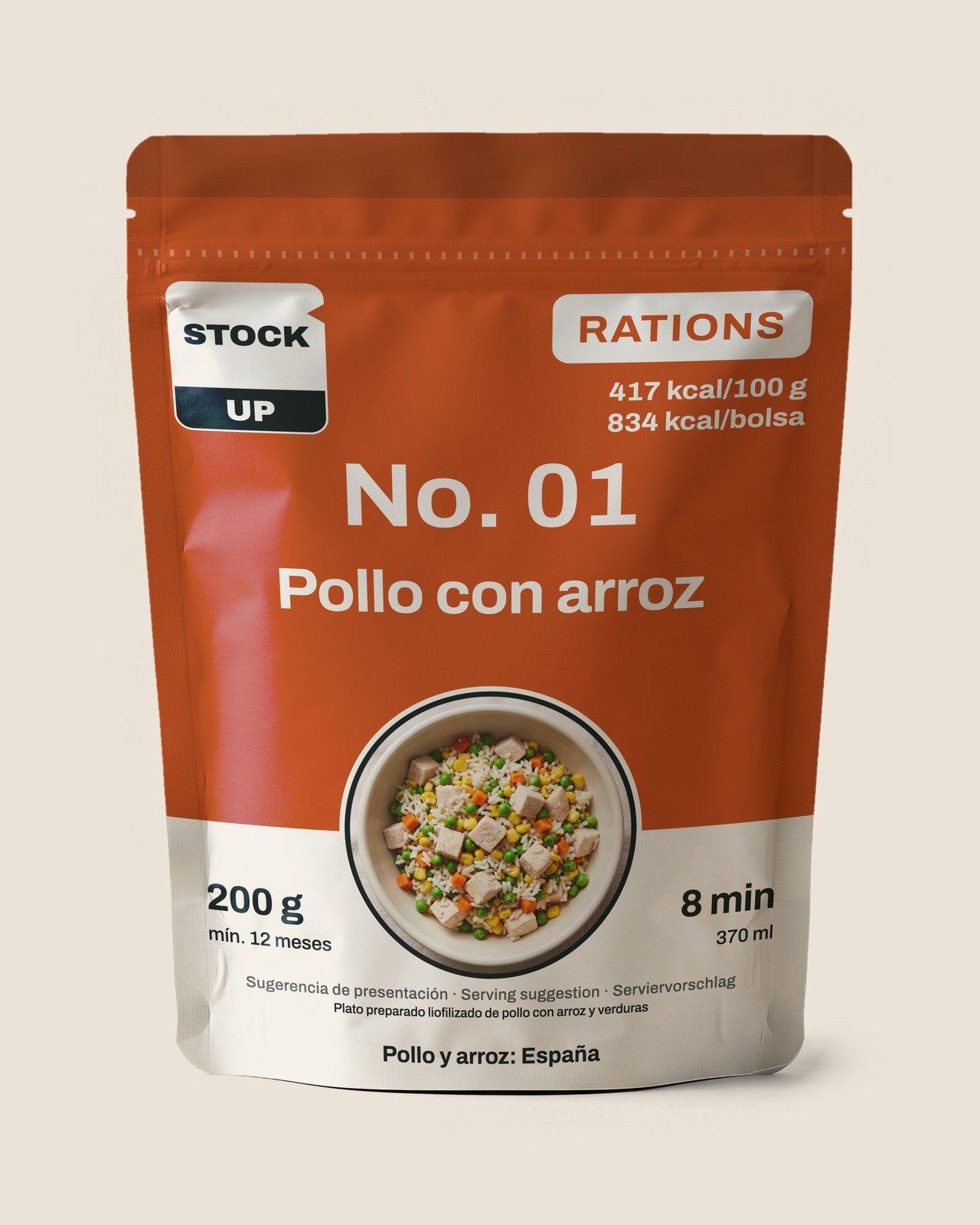
For a walk, that day can be nuts and bars, or meals: the One-Day Ration is breakfast to pudding in one box, with Chicken & Rice for lunch. For three days at home, the 72-Hour Food Reserve does the same job at a larger size. Both need water to make up, so by the same order the water comes first.
From our range
Chicken & RiceLarge
Sources
Accessed 10 November 2026
- Rule of Three (opens an external website)
- If You Get Lost (opens an external website)
- Page on 112, the European emergency number (opens an external website)
- Outdoor Emergency Plan (opens an external website)
- Cerebral hypoxia (opens an external website)
- Cold water shock (opens an external website)
- Heat-related illnesses (opens an external website)
- A new look at survival times during cold water immersion (opens an external website)
- 10 Essentials (opens an external website)
- Water, hydration, and health (opens an external website)
- Vorsorgen für Krisen und Katastrophen (opens an external website)
- A mathematical model of weight loss under total starvation: evidence against the thrifty-gene hypothesis (opens an external website)
- Consideraciones nutricionales en montaña (opens an external website)
- Statistics Report 2025 (opens an external website)
Hear from us before the shop opens
Leave your email. After a quick confirmation you get a welcome, a couple of short notes about our food and one email the day ordering opens. Nothing else.