Food for a flying day: what to take to the airfield
The met read, the walk-round done, two flights before lunch and the café shut when you land. A day at a small airfield wants food that weighs little, needs no flame near the apron and waits in the bag until you’re down.
By STOCKUP · Updated
In this guide (6)
Lunch goes on the mass and balance
Before the first flight, the pilot in command signs off the load. Part-NCO, the EU rulebook for non-commercial flying in light aeroplanes and helicopters, says you only start once you’re satisfied that “the mass of the aircraft and the centre of gravity location are such that the flight can be conducted within limits”, with everything “properly loaded and secured”.1 The sailplane rules say the same.2 Lunch is baggage, and on a PPL you do the weight and balance with it in.
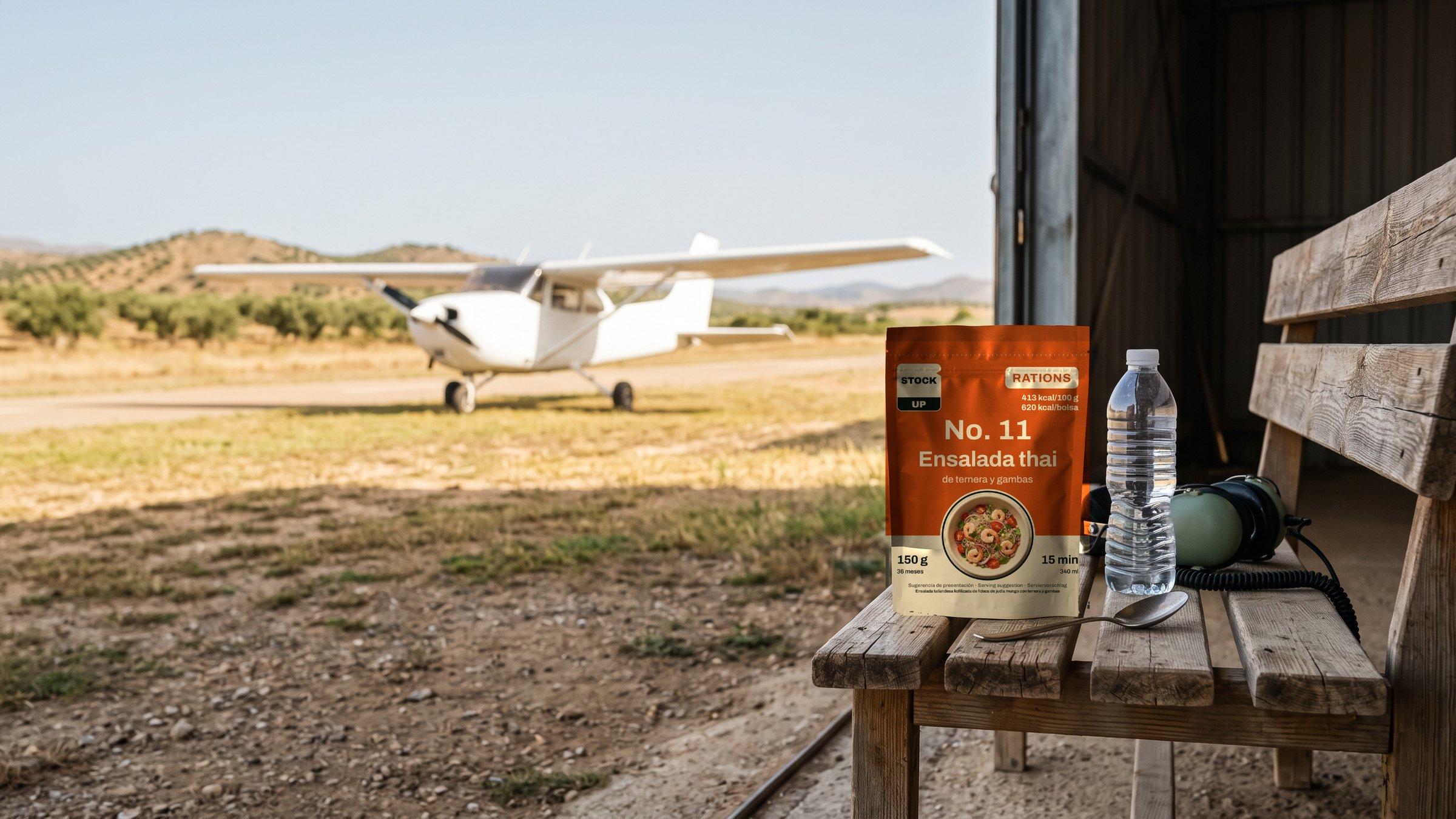
That part is easy. The food is cooked first, then freeze-dried whole, so Thai Beef & Prawn Noodle Salad weighs 150 g dry. The heavy part of a meal is water, and the water can wait for the ground: a bottle filled at the clubhouse, or brought from home.
| Pouch | Net weight | Water | Cold water | Hot water |
|---|---|---|---|---|
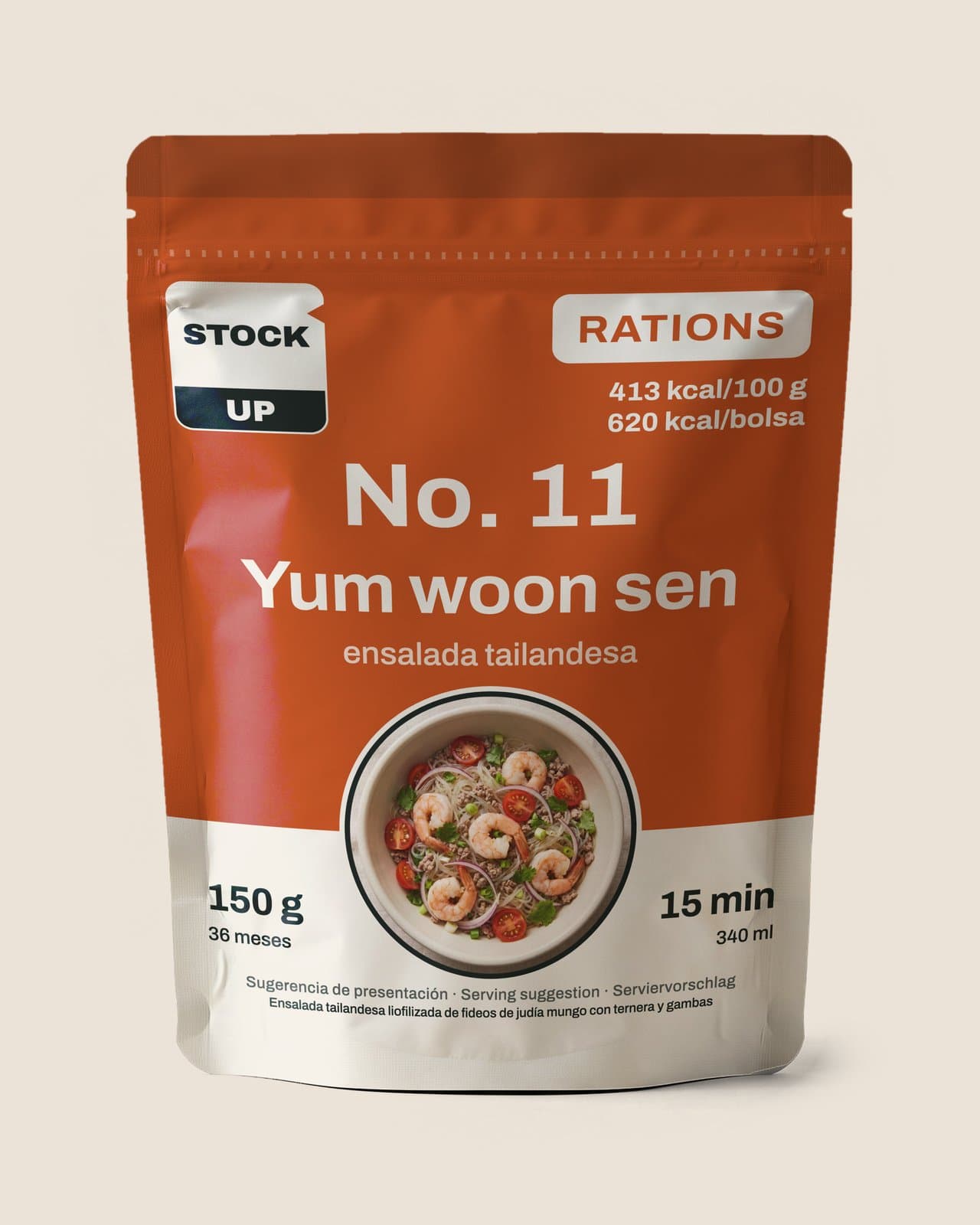 Thai Beef & Prawn Noodle SaladLarge | 150 g | 340 ml | about 15 min | 5 min |
 Chicken & RiceLarge | 150 g | 400 ml | about 20 min | 8 min |
 Porridge & Fruit | 90 g | 250 ml | about 20 min | 5 min |
 Strawberry Shake | 35 g | 250 ml | 2 min | Cold water only |
 Puchero Broth | 60 g | 250 ml per cup | Hot water only | 1 min |
What each pouch weighs dry, and the water it takes
- Thai Beef & Prawn Noodle SaladLarge
- Net weight
- 150 g
- Water
- 340 ml
- Cold water
- about 15 min
- Hot water
- 5 min
- Chicken & RiceLarge
- Net weight
- 150 g
- Water
- 400 ml
- Cold water
- about 20 min
- Hot water
- 8 min
- Porridge & Fruit
- Net weight
- 90 g
- Water
- 250 ml
- Cold water
- about 20 min
- Hot water
- 5 min
- Strawberry Shake
- Net weight
- 35 g
- Water
- 250 ml
- Cold water
- 2 min
- Hot water
- Cold water only
- Puchero Broth
- Net weight
- 60 g
- Water
- 250 ml per cup
- Cold water
- Hot water only
- Hot water
- 1 min
Cold water next to the hangar
The apron is no place for a camping stove. ICAO’s airport services manual says open flames “should be prohibited on the apron and in other locations within 15 m of any aircraft fuelling operation”.3 That’s guidance for airports, not law. The EU rule for the pilot is narrower: no smoking on board while the aircraft is being refuelled.1 Each airfield adds its own rules, and they differ.
Thai Beef & Prawn Noodle Salad is the no-stove lunch: about 15 minutes with cold water, which is how it’s meant to be eaten, or 5 minutes with warm water, not boiling. The lime sachet goes in last. Chicken & Rice takes cold water too, for about 20 minutes. The minutes for every pouch are in cold or hot water.
Two stay on the ground. The Strawberry Shake is cold water only, shaken in a bottle for about 2 minutes, and keeps 6 months: a clubhouse drink, not kit. The Puchero Broth is hot water only, 250 ml per cup and 6 cups to a pouch. That’s the clubhouse kettle on a winter morning, before anyone has pulled the aeroplane out.
A flying day, meal by meal
Breakfast comes before the met and the walk-round. Porridge & Fruit takes 5 minutes with the kettle at home, or about 20 minutes with cold water. For the met, AEMET, Spain’s weather service, runs AMA, an aeronautical self-service with METAR, TAF, GAMET, SIGMET and significant-weather charts for registered aviation users, at no extra cost once you’ve applied for access.4
Lunch falls between flights, on the bench by the hangar or at the launch point while the thermals make up their mind. On this coast that might be La Axarquía, near Vélez-Málaga, run by the Real Aeroclub de Málaga: 959 m of asphalt, AVGAS and Jet A-1. Visiting aircraft ask the club for permission to land, and the radio there is in Spanish.5
The café may be shut when you land, so Chicken & Rice rides in the bag for later. If the weather sends you to an alternate, dinner goes with you.
Over the sea or the sierra, the kit is your call
The EU rule is one sentence. Aeroplanes flown over areas “in which search and rescue would be especially difficult” carry signalling devices and “life-saving equipment, including means of sustaining life, as may be appropriate to the area overflown”; helicopters, the same.1 Over water, the pilot in command weighs the risk of a ditching and decides what goes aboard.1
EASA’s acceptable means of compliance, its guidance on meeting the rule, goes further. When the extra kit is required (for a single-engine aeroplane, more than half an hour at cruising speed from easier terrain), it lists 500 ml of water for each four, or fraction of four, persons on board, a knife, first-aid equipment and a set of air/ground codes.6 It says “should”, not “shall”, and it names no food.
Gliders have their own rulebook, Part-SAO, without the words about sustaining life.2 Microlights and paragliders sit outside the EU rules altogether,7 and Spain’s microlight decree says nothing about survival equipment.8 ENAIRE, Spain’s air navigation service, designates no area as especially difficult in the AIP,9 and AESA, the aviation safety agency, publishes no food list we could find. On a Costa del Sol day out, what goes in the kit is mostly your own choice.
Hot cockpits and the date on the back
The FAA’s Federal Air Surgeon says many light aircraft cabins “readily heat up in the summer sun”.10 The nearest measured figure is for a car: in a US study, a dark saloon shut on clear days of 22–36 °C warmed by about 22 °C in an hour, most of it in the first half hour.11 A canopy on a Costa del Sol apron in August won’t be kinder.
So the pouches travel in your bag, stay out of the cockpit between flights and go home with you. Your own water is another matter: the FAA’s glider handbook tells pilots to take water on every flight.12
Each sealed pouch has its date on the back, and the months for each dish are in how long freeze-dried food keeps. Opened and not made up, a main keeps 24 hours; once the water’s in, eat it.
What the pouches leave to you
The pouches are the meals. The rest of the flight bag is on this list.
The rest of the flight bag
0 of 7 ticked
Your ticks stay in this browser only.
Flying the coast by sea instead? The same day afloat is in provisioning a sailing weekend, and every pouch for the outdoors is in Outdoor meals.
From our range
Thai Beef & Prawn Noodle SaladLarge
Sources
Accessed 7 November 2026
- Commission Regulation (EU) No 965/2012 laying down technical requirements and administrative procedures related to air operations (opens an external website)
- Commission Implementing Regulation (EU) 2018/1976 laying down detailed rules for the operation of sailplanes (opens an external website)
- Aircraft fuelling operation (opens an external website)
- ¿Qué es el AMA? (opens an external website)
- La Axarquía // LEAX (opens an external website)
- Easy Access Rules for Air Operations (opens an external website)
- Regulation (EU) 2018/1139 on common rules in the field of civil aviation and establishing a European Union Aviation Safety Agency (opens an external website)
- Real Decreto 765/2022, de 20 de septiembre, por el que se regula el uso de aeronaves motorizadas ultraligeras (ULM) (opens an external website)
- GEN 3.6 Search and rescue (opens an external website)
- Aeromedical advisory: a pilot’s guide to hypothermia and hyperthermia (opens an external website)
- Heat stress from enclosed vehicles: moderate ambient temperatures cause significant temperature rise in enclosed vehicles (opens an external website)
- Glider Flying Handbook (opens an external website)
Hear from us before the shop opens
Leave your email and we’ll ask you to confirm it, write to you about our food before the launch, and send a note the day ordering opens.