Non-perishable food: the list for a home reserve
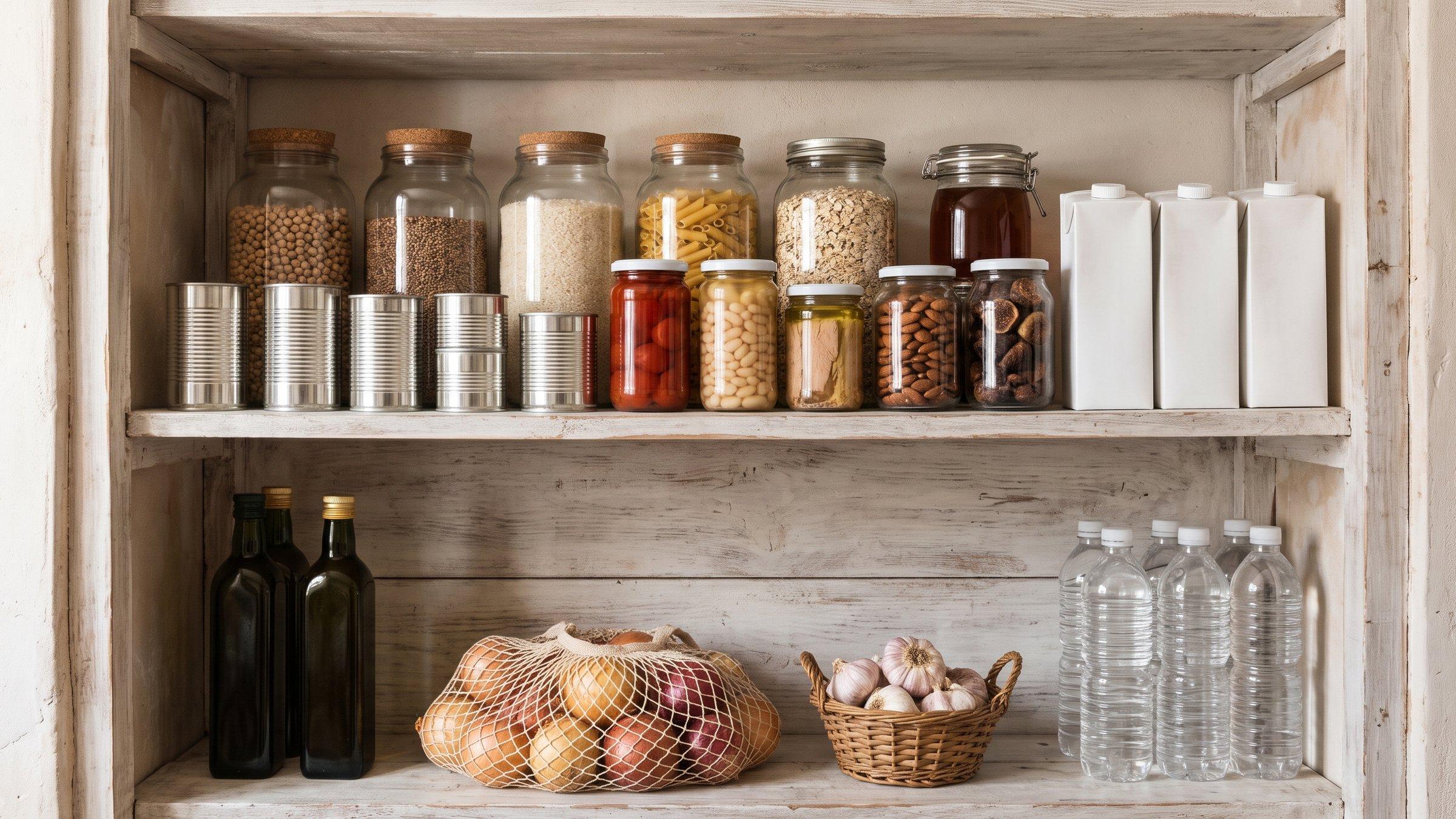
A larder is the one part of the kitchen that still works with the power off and the shops shut. Most of what goes in it you already buy; the question is how long each thing keeps.
By STOCKUP · Updated
In this guide (6)
Non-perishable means it asks for nothing special
Spain’s food code, the Código Alimentario, defines only perishable food: food that needs special conditions to keep while it’s stored and carried.1 Retail law draws its own line at thirty days, or the need for a controlled temperature.2 Non-perishable is everything else, which is a definition by leftovers, but a useful one: food that keeps on a shelf, unopened, without a fridge.
That doesn’t mean it keeps for ever. Almost everything in a larder carries a date, and it matters which of the two kinds it is.
The larder, group by group
The list follows the groups OCU, the Spanish consumers’ organisation, uses for its larder basics, with water added at the top.5 Where a source gives a shelf life, it’s in the note.
A larder that keeps
0 of 19 ticked
Your ticks stay in this browser only.
Potatoes and onions are on OCU’s list too, fresh as they are.5
Tins: one to two years, or five
How long a tin keeps depends on whom you ask. Germany’s federal food agency, the BLE, publishes storage periods for a household stock; OCU gives typical figures for Spain. No British or Spanish authority page we read puts months on a tin.
| BLE (Germany) | OCU (Spain) | |
|---|---|---|
| Tinned vegetables | 1–2 years6 | About 5 years5 |
| Tinned fish | Several years6 | About 5 years5 |
| Rice and pasta | 1 year, in a closed jar6 | “A long time”, no figure5 |
| Dried fruit and nuts | 1 year (dried fruit)6 | Many months, even years5 |
| Cooking oil | 6–12 months; 4–8 weeks open6 | No figure |
| UHT milk | No figure | Several months5 |
| VerdictWhat decides | The date on the pack | The date on the pack |
How long it keeps unopened, by two sources
Tinned vegetables
Tinned fish
Rice and pasta
Dried fruit and nuts
Cooking oil
- BLE (Germany)
- 6–12 months; 4–8 weeks open6
- OCU (Spain)
- No figure
UHT milk
- BLE (Germany)
- No figure
- OCU (Spain)
- Several months5
VerdictWhat decides
- BLE (Germany)
- The date on the pack
- OCU (Spain)
- The date on the pack
Neither figure is a legal limit. The German ones read as cautious storage periods for a household stock, the Spanish ones as the dates you’d typically find printed. The BLE itself says to go by the date on anything you’ve bought.6 One rule has no exceptions: a tin that has bulged outwards goes in the bin, unopened.10
What the official lists ask for
Protección Civil, the Spanish government’s civil protection directorate, puts “non-perishable food” on its seven-item kit list, with no quantity and no examples.9 The UK’s Be Ready campaign is more specific: food for three days that needs no fridge and no cooking, such as tinned meat, fish or vegetables, dried fruit and nuts, and food you normally eat.7 Between them, that’s the first two groups of the list above.
The American list is the longest: Ready.gov, the preparedness site of FEMA, the US federal emergency agency, asks for “at least a several-day supply of non-perishable food” and names, in this order, ready-to-eat tinned meat, fruit and vegetables with a tin opener, protein or fruit bars, dry cereal or granola, peanut butter, dried fruit, tinned juice, non-perishable pasteurised milk, high-energy foods, food for infants, and comfort foods.12 The American Red Cross puts a time on it: three days’ supply to take if you evacuate, two weeks’ at home.14 Who asks for what, and the water figures country by country, are in what the EU and Spain ask you to keep.
Buy what you eat, eat the oldest first
A larder only works if it turns over. The BLE’s rule is simple: new stock goes to the back or the bottom, and the older stock gets eaten first. Write the purchase date on anything that came without one.10 Germany’s civil protection office calls it a living stock: buy one or two extra at each shop, cook from the reserve, and replace what you used.11 OCU says the same in fewer words: use it and replace it.5
Ready.gov adds four lines of upkeep: tins in a cool, dry place, boxed food in tightly closed plastic or metal containers, expired items replaced, and the whole kit re-thought every year as the household changes.13
Be Ready’s “food you normally eat” is the other half.7 A tin of something nobody likes stays at the back until its date, and then it’s waste.
Where a freeze-dried meal fits
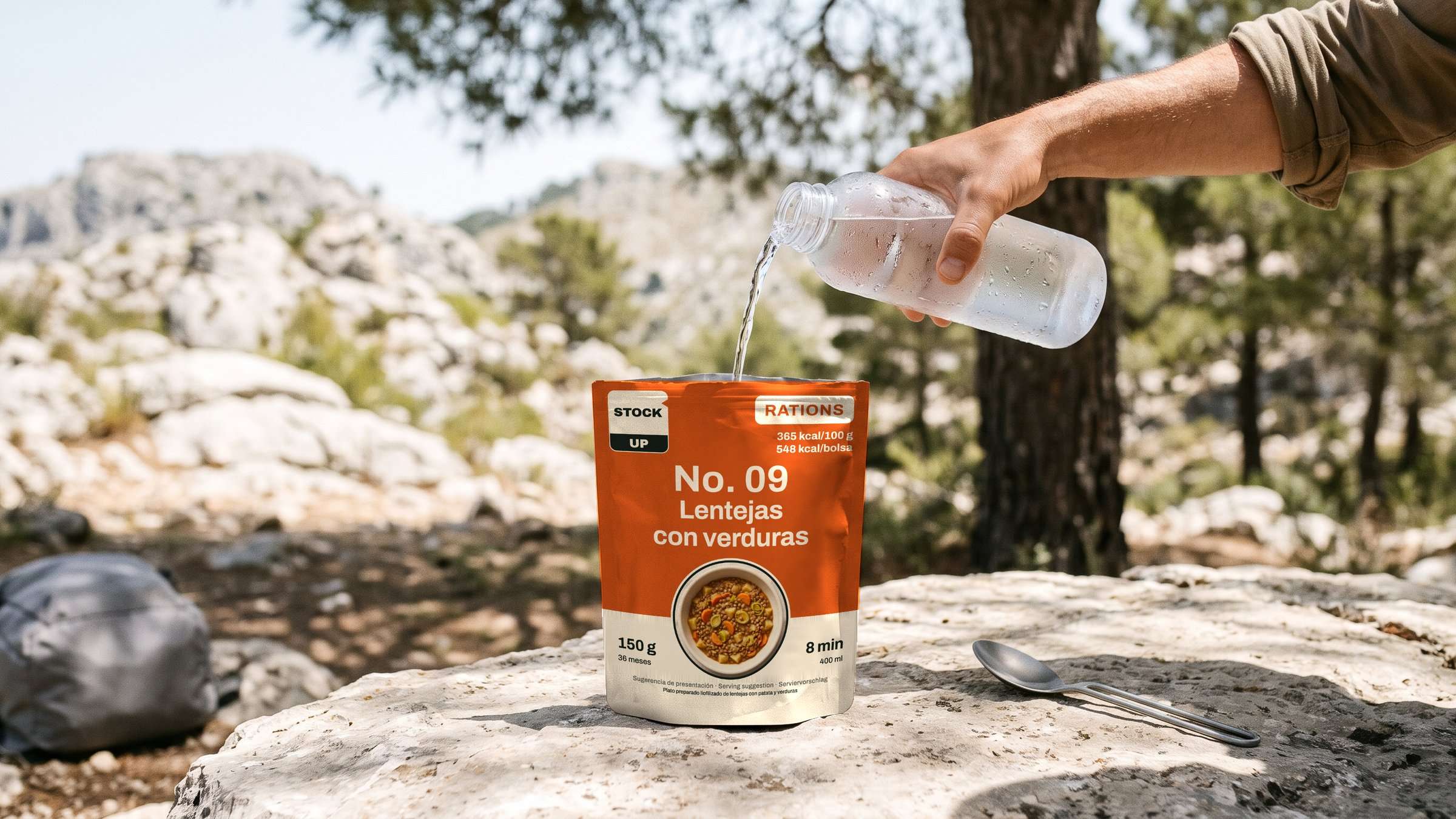
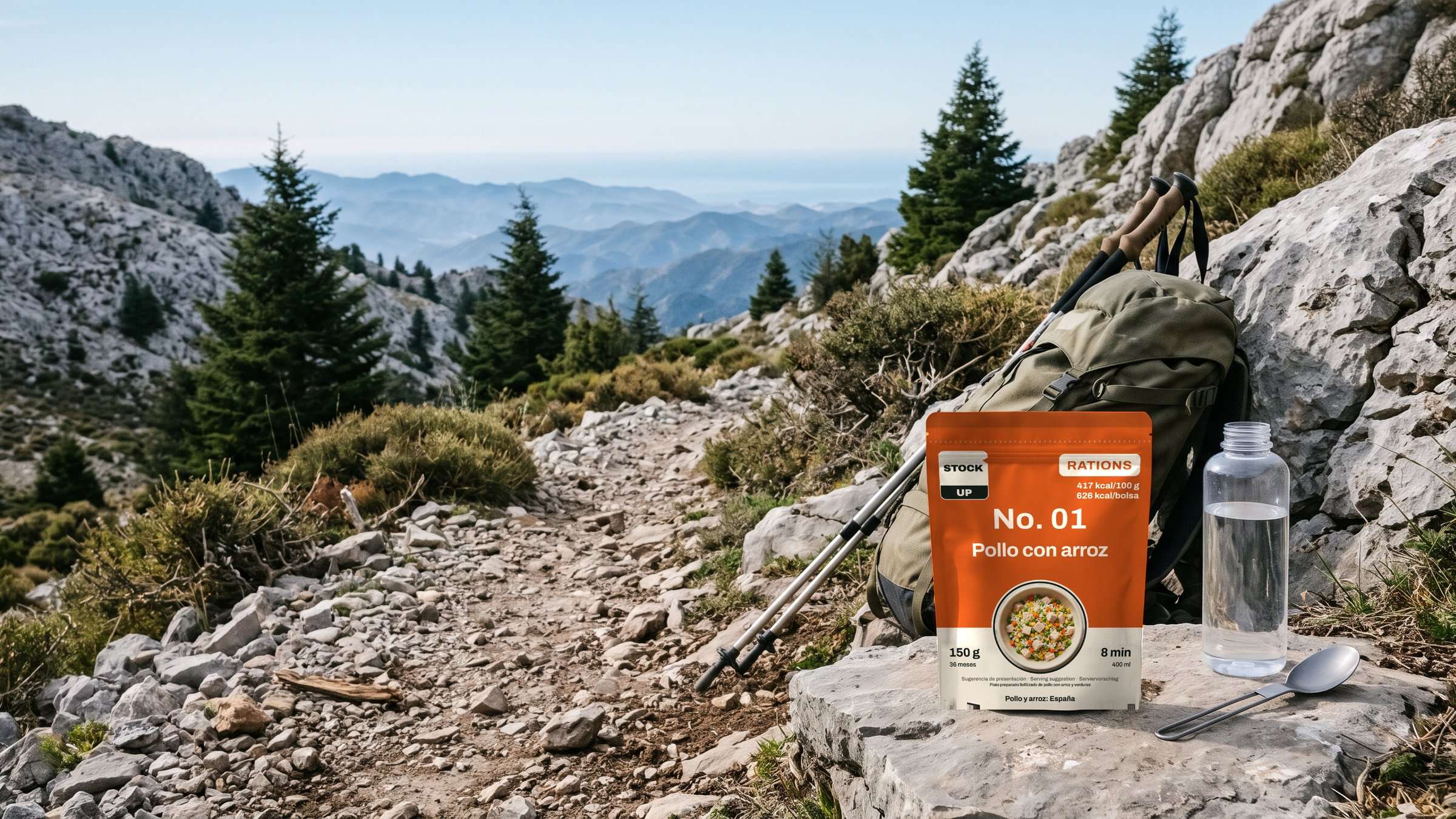
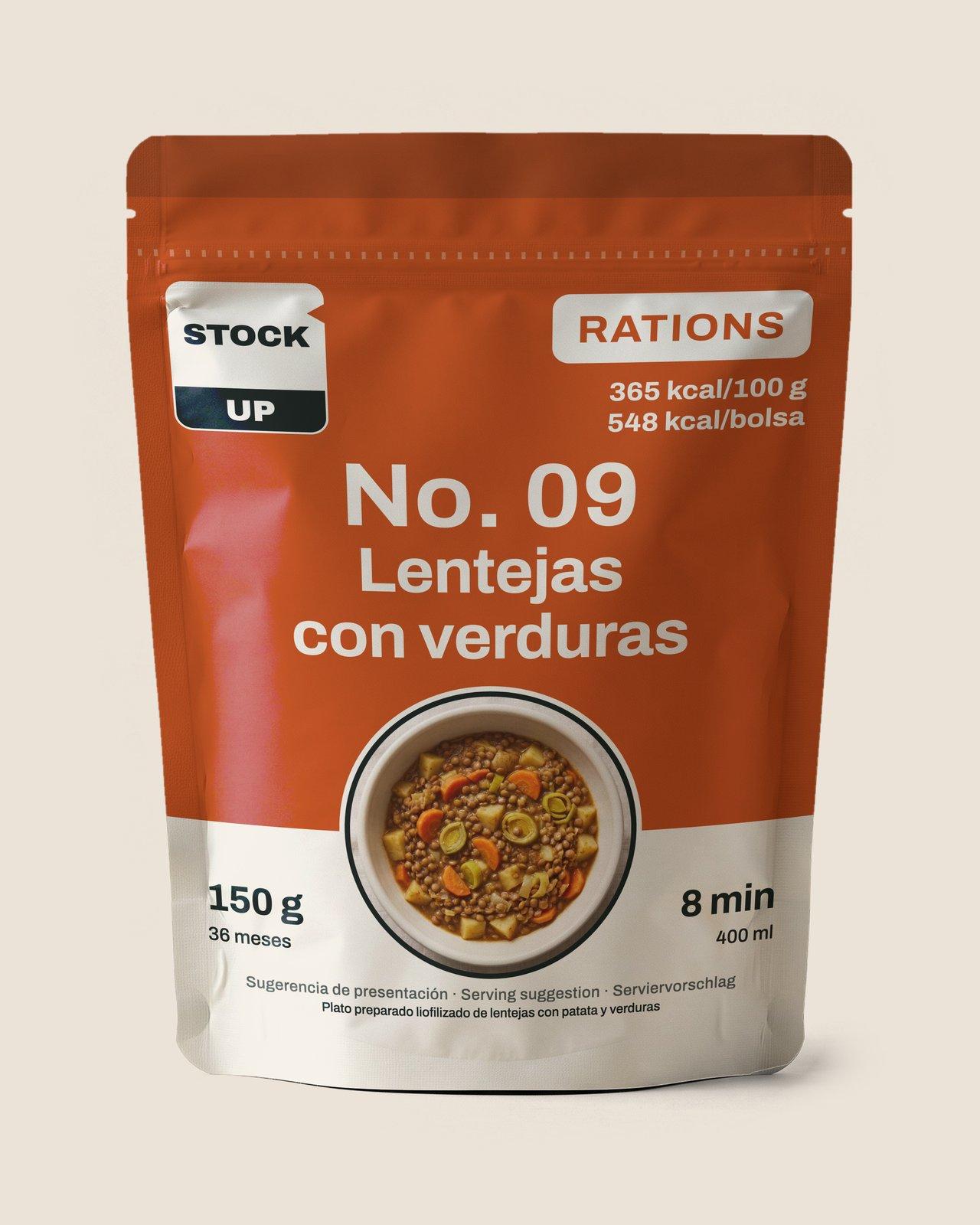
None of the official lists names freeze-dried meals. What a pouch adds to the larder is a cooked dish rather than an ingredient: Lentil & Vegetable Stew is a whole lentil stew, sealed for 36 months, and Porridge & Fruit is breakfast, sealed for 36 months.
The catch is water. It isn’t “no cooking” in the British sense, because a pouch needs water before it’s a meal: 400 ml for the stew, about 20 minutes if the water is cold. Count that on top of what you drink. Some need it hot: Puchero Broth is hot water only. The months for every pouch are in how long freeze-dried food keeps, and a three-day plan built from them is in the 72-hour kit list.
From our range
Lentil & Vegetable StewLarge
Sources
Accessed 7 November 2026
- Código Alimentario Español, Decreto 2484/1967 (opens an external website)
- Ley 7/1996 de Ordenación del Comercio Minorista (opens an external website)
- ¿Sabes la diferencia entre la fecha de consumo preferente y la fecha de caducidad? Nuevo vídeo informativo (opens an external website)
- Understanding food labelling: best before and use-by dates (opens an external website)
- Alimentos básicos para la despensa (opens an external website)
- So können Lebensmittel gelagert werden (opens an external website)
- Be ready for emergencies (opens an external website)
- ¿Qué hacer con los alimentos del frigorífico y del congelador después del apagón eléctrico? (opens an external website)
- Plan Familiar de Emergencias (opens an external website)
- So pflegen Sie Ihren Lebensmittelvorrat (opens an external website)
- Essen und Trinken bevorraten (opens an external website)
- Food (opens an external website)
- Build a kit (opens an external website)
- Survival kit supplies (opens an external website)
Hear from us before the shop opens
Leave your email and we’ll ask you to confirm it, write to you about our food before the launch, and send a note the day ordering opens.