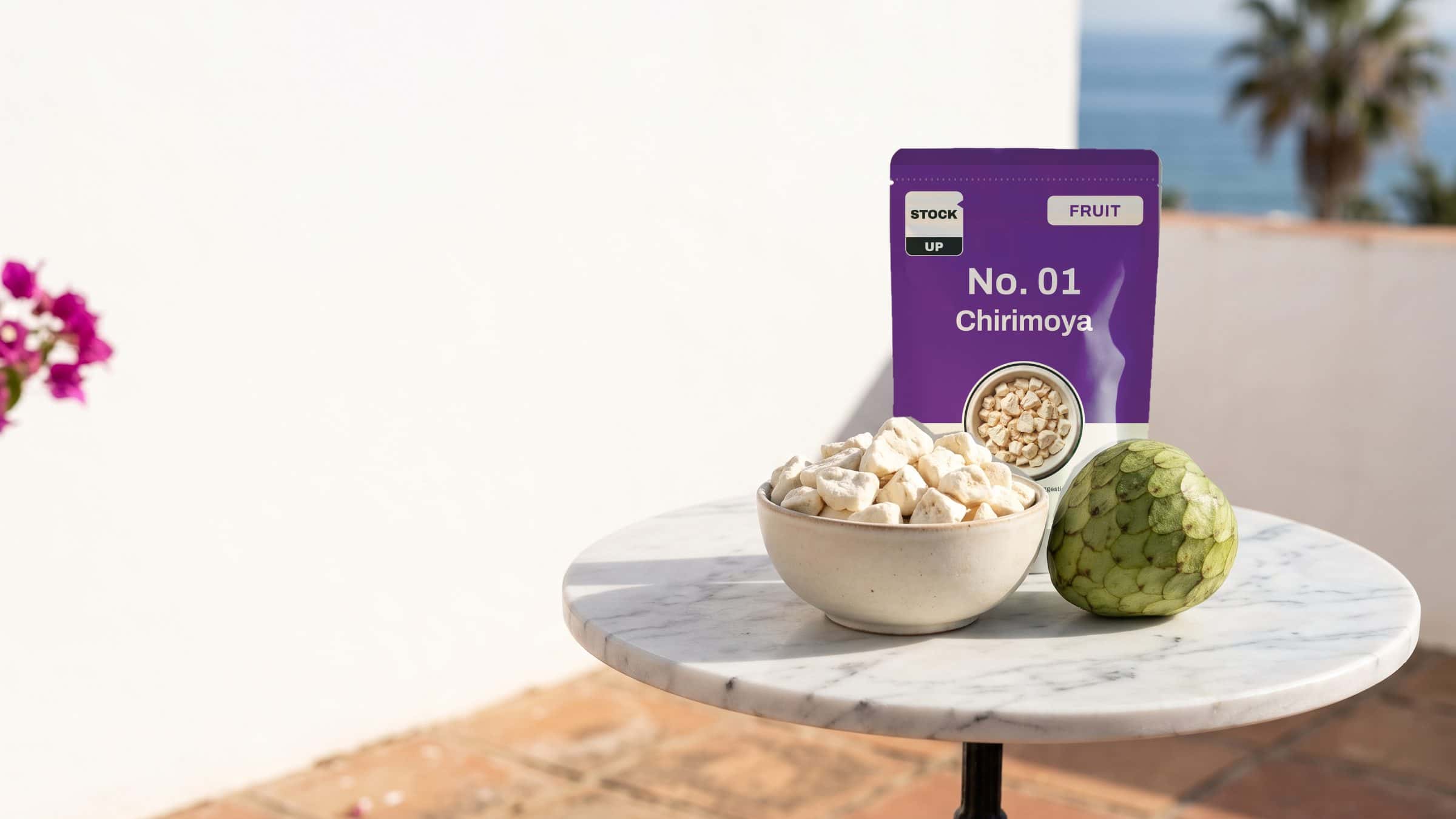
Cherimoya: when it’s in season in Spain and how to eat it
The fruit with the rough green skin on autumn market stalls is sold hard and ripens in the fruit bowl. The fridge is where it goes wrong.
By STOCKUP · Updated

In this guide (6)
What it is, and what it’s called here
- The season, at its height in October (the growers’ regulatory council)1
- Oct–May
- Water in the fresh flesh2
- 76.9%
- Of the fruit you can eat; the rest is skin and seeds2
- 60%
The cherimoya (chirimoya in Spanish) is the fruit with the rough green skin that turns up on market stalls in autumn. Inside it’s soft white flesh and large black seeds.3 In English it’s one of the fruits called custard apple,3 which is why that name can mislead: the soursop, guanábana in Spanish, is another kind of custard apple and another species altogether, a large fruit whose green skin is covered in points.413 Ask for chirimoya and you’ll get the right one.
The season, and the coast that grows it
The growers’ council puts the height of the season in October and says production now runs into May.1 There are two harvests because growers prune at two dates: pruned in April, the trees flower in late spring and fruit in autumn; pruned in May, they flower in late summer and fruit in spring.5
Spain’s cherimoyas come overwhelmingly from Granada: in the ministry’s 2022 figures, about 41,200 of Spain’s 43,500 tonnes, with Málaga at about 1,800.6 The fruit with a protected designation of origin, Chirimoya de la Costa Tropical de Granada-Málaga, comes from fifteen named municipalities on a strip of about 85 km between Motril and Vélez-Málaga, ten in Granada and five in Málaga: Nerja, Frigiliana, Torrox, Algarrobo and Vélez-Málaga.7 The western Costa del Sol isn’t in the zone. Only one variety qualifies, Fino de Jete, a local selection made in the late 19th century in Jete, in the Río Verde valley, and today more than 90% of the cherimoya grown on that coast. The rules ask for fruit that is sweet with a slightly acid edge, with white or ivory flesh, and every pack carries the council’s numbered label.7 Only fruit with that label is PDO fruit.
Ripe or not, and how to finish it at home
A cherimoya is usually sold firm and ripens in your kitchen. Ripe, the council says, the flesh is soft, honeyed and sweet.1 The PDO rules describe the fruit at picking point: the skin turns from a deep to a pale green and its scales flatten.8 At home, go by feel: a ripe fruit gives a little under the flat of your fingers. The skin is fragile,1 so press, don’t squeeze.
Step by step
Choose one with unbroken skin
Whole, no splits, no dark patches. Carry it on top of the shopping, not under it.Ripen it at room temperature
In the fruit bowl, out of the sun. A firm fruit is ready in three or four days at room temperature.9Eat it soon once it gives
It goes over fast once ripe, so don’t leave it waiting.1
The FAO’s usual way with firm fruit is about five days at 15–20 °C.9 The fridge rule has numbers behind it: researchers at Spain’s CSIC found 8 °C was the coldest Fino de Jete fruit would take for long storage, and fruit held for twelve days at 6 °C, then warmed, failed to ripen and browned badly.10
How to eat it
Cut it in half and eat the flesh with a spoon, which is the council’s own advice.1 Spit out or pick out the seeds as you go: they’re large, black and come away easily.1 Don’t eat them, and don’t crush them into a smoothie: the seeds contain substances described in the scientific literature as toxic.12 The skin isn’t eaten either.
Beyond the spoon, it goes into fruit salads, juices, ice cream and sorbet.9 For a smoothie, scoop out the flesh, take every seed out, and blend.
Per 100 g, fresh and freeze-dried
| Fresh flesh | Freeze-dried | |
|---|---|---|
| Energy | 87 kcal2 | 364 kcal |
| VerdictWhat the difference is | About three-quarters water | The same flesh with the water drawn off |
Cherimoya per 100 g: fresh flesh and our freeze-dried bag
Energy
- Fresh flesh
- 87 kcal2
- Freeze-dried
- 364 kcal
VerdictWhat the difference is
- Fresh flesh
- About three-quarters water
- Freeze-dried
- The same flesh with the water drawn off
Per 100 g of fresh flesh, Spain’s food composition database also lists 1 g of protein, 20 g of carbohydrate and 1.9 g of fibre.2 A fruit of 400 g gives about 240 g you can eat, once the skin and seeds are off. Counted per fruit, the figure shrinks: Spain’s nutrition foundation, FEN, puts a whole 200 g cherimoya at 108 kcal, since only 120 g of it is flesh.14 The freeze-dried column is higher only because the water is gone: the same energy sits in fewer grams. The bag’s ingredient list says how much fresh fruit went into each 100 g.
Freeze-dried: the flesh without the water
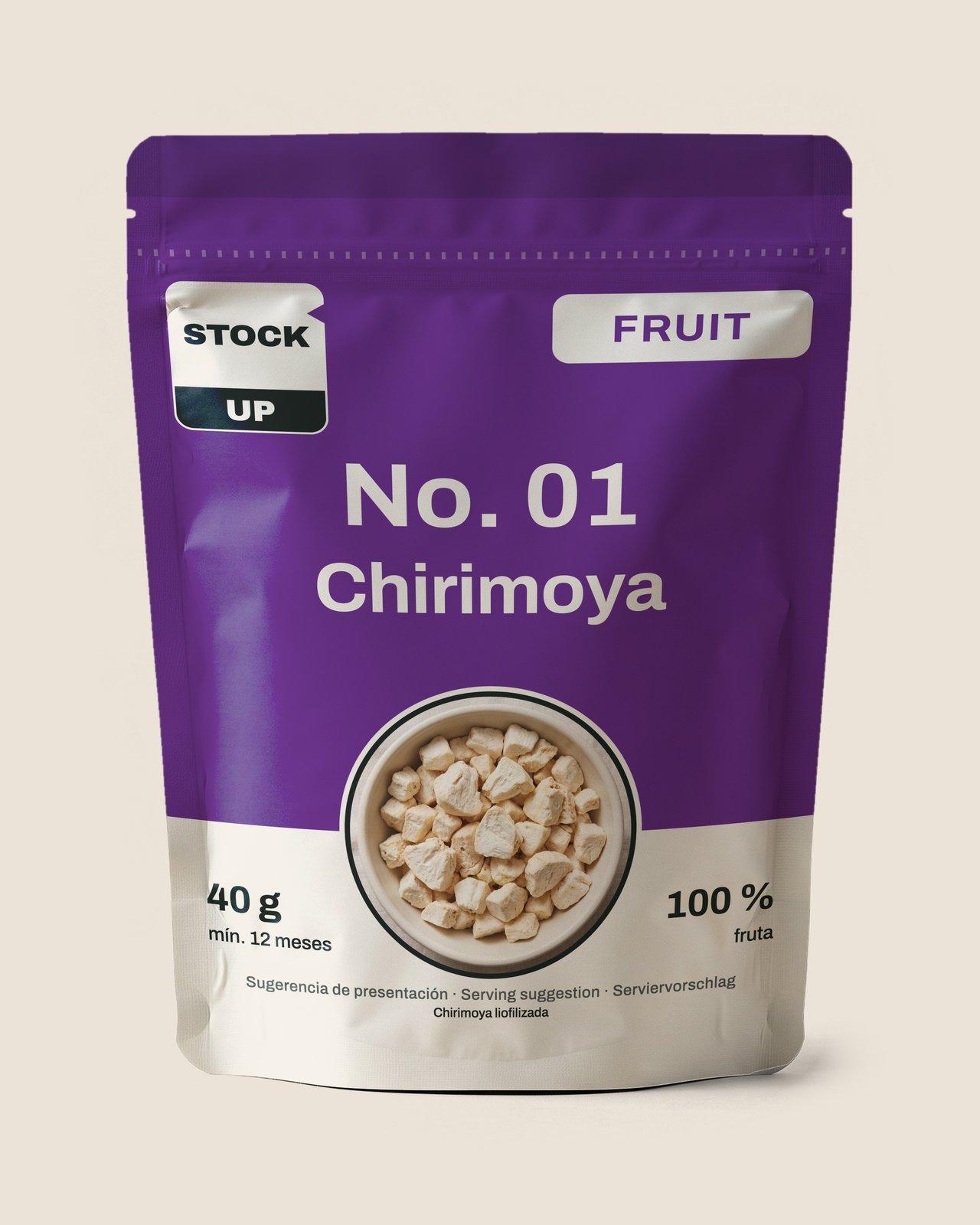
Cherimoya is cherimoya and nothing else: the flesh, frozen, then the ice drawn off as vapour. It keeps at least 12 months sealed, counted from the day the bag is closed. There’s a smaller bag, Cherimoya (15 g), and a Cherimoya Shake, made with cold water only. Eaten from the bag it crunches; on yoghurt or ground to a powder it does what how to use freeze-dried fruit describes. How it compares with ordinary dried fruit is in freeze-dried fruit, and what happens to a bag once it’s open in how long freeze-dried food keeps.
From our range
Cherimoya
Sources
Accessed 10 November 2026
- La chirimoya (opens an external website)
- Chirimoya (opens an external website)
- Cherimoya (opens an external website)
- Annona muricata L. (opens an external website)
- Tropicales. Boletín Fitosanitario Autonómico, campaña 2014-2015 (opens an external website)
- Anuario de Estadística 2023 (avance), tabla 7.9.13.2 (opens an external website)
- Pliego de condiciones de la DOP Chirimoya de la Costa Tropical de Granada-Málaga (opens an external website)
- Reglamento de la Denominación de Origen Chirimoya de la Costa Tropical de Granada-Málaga y de su Consejo Regulador (opens an external website)
- Fichas técnicas: Chirimoya (opens an external website)
- Tolerance of cherimoya (Annona cherimola Mill.) to cold storage (opens an external website)
- Prevenir intoxicaciones alimentarias en verano (opens an external website)
- Annona cherimola seed extract activates extrinsic and intrinsic apoptotic pathways in leukemic cells (opens an external website)
- Soursop (opens an external website)
- Chirimoya (opens an external website)
Hear from us before the shop opens
Leave your email. After a quick confirmation you get a welcome, a couple of short notes about our food and one email the day ordering opens. Nothing else.